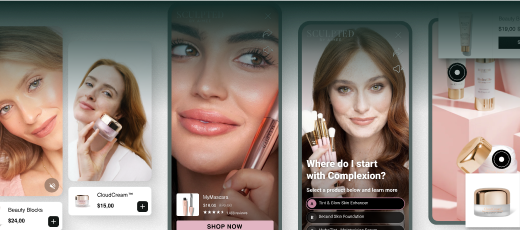
Acquiring a customer through social media used to be a multi-step game of telephone. You caught their attention with an ad, hoped they clicked a link, waited for your mobile site to load, and prayed they didn't get distracted before reaching the checkout. Today, that friction is disappearing. Social commerce allows brands to meet shoppers exactly where they are, turning a casual scroll into a confirmed transaction.
At Videowise, we focus on helping brands bridge the gap between social discovery and measurable revenue. Whether it is through in-app shops or bringing social-native video experiences to your own storefront, the goal is the same: increasing conversion rate (CVR) and average order value (AOV) by reducing the steps to purchase. For proof, browse the customer stories from brands turning video into revenue. This article explores real-world examples of social commerce and the strategies you can use to drive more revenue per session (RPS).
Social commerce is the process of selling products directly through social media platforms or using social-native content to drive transactions on your own site. Unlike traditional ecommerce, where social media acts purely as a top-of-funnel discovery tool, social commerce facilitates the entire journey from discovery to checkout within a social environment.
The core differentiator is the removal of the "click-out." In a social commerce model, a user leaves Instagram to visit your site. In a social commerce model, the storefront, product details, and payment processing all live within the app interface. This significantly reduces bounce rates caused by slow loading times or complicated mobile redirects.
Quick Answer: Social commerce is a subset of ecommerce that integrates shopping directly into social media platforms. It allows customers to discover, research, and purchase products without leaving their favorite apps, using features like in-app checkout, shoppable video, and live selling.
For an ecommerce operator, social commerce isn't just about "brand presence." It is about efficiency. As customer acquisition costs (CAC) continue to rise on platforms like Meta and Google, brands must squeeze more value out of every impression.
Social commerce addresses several critical performance metrics:
TikTok Shop has become one of the most visible examples of social commerce globally. It combines a massive creator ecosystem with a native checkout flow. Brands can list their products in a dedicated "Shop" tab, but the real power lies in shoppable short-form video.
A hydration brand, for instance, might partner with 50 creators to review a new product. Each of those videos can feature a direct link to the product within the TikTok interface. A user watches the video, taps the product card, and checks out using saved payment information. This "impulse-to-purchase" cycle is incredibly fast, often leading to massive sales spikes for viral products.
Key Takeaway: TikTok Shop is most effective when paired with an affiliate program. By letting creators earn a commission on direct sales, you turn your customer base into a decentralized sales force that drives high-intent traffic to your in-app store.
Instagram has evolved from a photo-sharing app into a visual discovery engine. For fashion and beauty brands, Instagram Shopping is a foundational social commerce example. It allows you to tag specific products in your feed posts, Stories, and Reels.
When a user taps a "Product Tag," they see the price, description, and an "Add to Bag" button. Instagram also offers a "Shop" tab on business profiles, acting as a mini-website where users can browse collections. For operators, the benefit here is the ability to use high-quality lifestyle imagery to sell products in a context that feels more organic than a standard display ad.
YouTube is unique because it serves as both a social platform and the world’s second-largest search engine. YouTube Shopping allows brands to pin products beneath their videos or feature them in "Shorts."
This is particularly effective for tech, home goods, or complex beauty products that require more explanation. A creator can film a 10-minute deep-dive review of a coffee machine, and the viewer can buy that exact model directly from the video description or a pinned product shelf. We have seen that this combination of long-form education and instant purchase capability leads to much higher consumer confidence.
Live shopping involves real-time video broadcasts where a host demonstrates products and viewers can buy them as they watch. This format is exploding in the US market, led by platforms like TikTok Live, Amazon Live, and TalkShopLive.
Large retailers like Sephora and Walmart use live events to launch new product lines or run flash sales. The real-time chat feature allows hosts to answer questions immediately—"Does this lipstick have a matte finish?" or "What is the sizing like?"—which directly overcomes common purchase objections.
Why Live Shopping Works for Revenue:
For a live-selling proof point, see Tibi’s live shopping case study.
Pinterest is where people go to plan—weddings, home renovations, or seasonal wardrobes. This makes it a high-intent platform for social commerce. "Product Pins" (formerly Buyable Pins) allow users to see real-time pricing and availability.
If a user is pinning ideas for a kitchen remodel and sees a toaster they like, they can buy it directly from the pin. Because Pinterest users are often in a "discovery" mindset rather than a "socializing" mindset, the traffic tends to have a higher intent to purchase compared to other social networks.
Conversational commerce uses messaging apps like WhatsApp, Facebook Messenger, and Instagram DMs to facilitate sales. Instead of a shopper browsing a catalog, they have a conversation with an AI agent or a live representative.
A shopper might send a DM asking, "Do you have these boots in a size 9?" The brand can reply with a direct checkout link for that specific size. This personalized experience mimics the feeling of an in-store personal shopper. It is a powerful way to recover abandoned carts and provide high-touch service that builds long-term loyalty.
While many examples of social commerce happen inside social apps, the most sophisticated brands are bringing those social behaviors to their own websites. This is known as on-site social commerce.
By embedding shoppable video carousels or "Stories" style modules on your homepage or product display pages (PDPs), you provide the same engaging experience a user gets on TikTok, but with full control over the data and brand environment. Our platform, Videowise, is built specifically for this. We help brands take the video content that is already working on social media and embed it on their Shopify store to drive higher CVR and RPS without slowing down the site.
If you are just getting started, the shoppable video guide is a helpful next step.
Social proof is the backbone of social commerce. A UGC hub is a section of your website that pulls in photos and videos from real customers on social media.
Brands like Converse and GoPro use these galleries to show their products in the real world. When these galleries are "shoppable"—meaning you can click a customer's photo and buy the items they are wearing—they become a high-converting revenue channel. It bridges the gap between seeing a peer use a product and owning it yourself. For a deeper primer, read the UGC guide.
Augmented Reality (AR) is becoming a standard feature in social commerce, particularly for eyewear, makeup, and furniture. Platforms like Snapchat and Instagram allow users to "try on" a pair of sunglasses or see how a new rug looks in their living room using their smartphone camera.
This isn't just a gimmick; it is a conversion tool. By allowing the customer to visualize the product in their own environment, you reduce the uncertainty that often leads to cart abandonment or high return rates.
Bottom line: AR features in social commerce move the customer from "Is this right for me?" to "I need this" by providing a digital trial of the product.
Participatory commerce involves the community in the product creation process. Brands like Betabrand or various Kickstarter-style models use social media to let users vote on designs or colors they want to see produced.
Once the community has "voted" for a product, they are much more likely to buy it when it launches. This turns social commerce into a feedback loop where your audience dictates your inventory, significantly reducing the risk of unsold stock and ensuring high demand from day one.
| Format | Primary Platform | Best Metric to Track | Implementation Effort |
|---|---|---|---|
| In-App Shop | TikTok, Facebook | Total Direct Revenue | Medium (Catalog Sync) |
| Shoppable Video | Instagram Reels, TikTok | Conversion Rate (CVR) | High (Content Production) |
| Live Shopping | Amazon Live, YouTube | Average Order Value (AOV) | High (Production/Hosting) |
| On-Site Video | Brand Website | Revenue Per Session (RPS) | Low (Using Videowise) |
| AR Try-On | Snapchat, Instagram | Return Rate Reduction | Very High (3D Modeling) |
Not every brand needs to be on every platform. Your strategy should be dictated by where your audience spends their time and the complexity of your product.
Focus on Instagram and TikTok. These platforms are highly visual and rely on aesthetic appeal. Use Shoppable Reels and Creator Partnerships to show the products in motion. On-site, use shoppable video carousels on your PDPs to show how different sizes and shades look on real people.
Focus on YouTube and Pinterest. These products often require more research. Long-form "how-to" videos on YouTube can address technical questions, while Pinterest catches shoppers in the early planning stages of a room or project.
Focus on TikTok Shop and Live Shopping. If you sell a product with a lower price point that is easy to understand, you can thrive on impulse purchases. Running regular live streams with "limited-time" discounts can move high volumes of inventory quickly.
The technical side of social commerce often scares operators away. However, most modern platforms have simplified the integration process.
Step 1: Sync your catalog. Use a tool to connect your Shopify or BigCommerce catalog to Meta and TikTok. This ensures your pricing and inventory are always accurate across all social shops.
Step 2: Centralize your content. Use a library or hub to store all your video assets and UGC. This makes it easier to repurpose a high-performing TikTok video as a shoppable module on your website.
Step 3: Set up attribution. Use performance analytics to track which creators and which videos are actually driving revenue. Don't settle for "engagement" metrics like likes or shares; look for direct and influenced revenue.
Step 4: Optimize for speed. If you are bringing social commerce to your site, ensure it doesn't hurt your Core Web Vitals (the metrics Google uses to measure page speed and user experience). We built our infrastructure to ensure that adding high-quality shoppable video doesn't slow down your site performance.
For a deeper technical walkthrough, read our shoppable video performance guide.
Even with the best examples to follow, many brands struggle with execution. Here is what to watch out for:
We are moving toward a world where every piece of content is a storefront. The distinction between "content" and "commerce" is blurring. For brands, this means your video strategy is no longer a separate department—it is your sales strategy.
By leveraging the examples above—from in-app shops to on-site shoppable video—you can build a resilient revenue engine that doesn't rely solely on expensive top-of-funnel ads. The key is to stay focused on the metrics that matter: reducing friction, building trust through social proof, and ultimately increasing the value of every session on your store.
At Videowise, we are committed to providing the infrastructure that makes this possible. We help you turn every video asset into a measurable revenue channel, ensuring that your brand stays ahead in the fast-evolving world of video commerce.
If you are ready to add this to your store, install Videowise from the Shopify App Store.
If you want a tailored walkthrough first, book a demo.
Ecommerce refers to the broad category of online buying and selling, usually on a dedicated website or marketplace. Social commerce is a specific subset where the shopping experience—from discovery to checkout—happens directly within or is powered by social media platforms and their native content.
No. While a large following helps, social commerce often relies more on the "discovery" algorithms of platforms like TikTok and Instagram, as well as the reach of influencers and creators. Even a brand with a small following can generate significant revenue through viral shoppable videos or a well-managed affiliate program.
In-app social commerce (like TikTok Shop) doesn't affect your site speed as it happens off-platform. However, adding social-style video to your own website can slow it down if not handled correctly. Using a performance-first video commerce platform ensures that your shoppable videos load efficiently without hurting your Core Web Vitals.
Conversion rates vary by industry, but platforms with native in-app checkout—like Instagram and TikTok—typically see higher CVR because they remove the friction of leaving the app. For on-site conversions, shoppable video modules on product pages are often the most effective way to lift CVR and AOV.