.png)
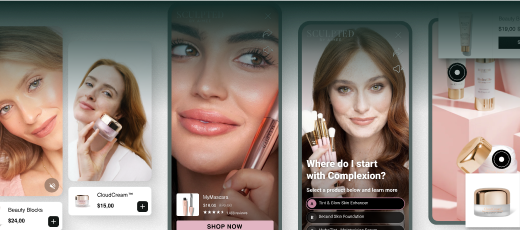
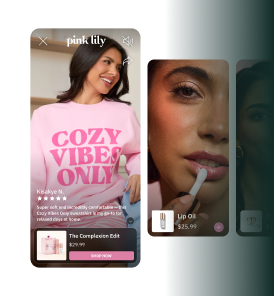
Shoppable video is interactive video content that allows viewers to purchase products directly within the video experience.
Think of it as the evolution of product videos: instead of passively watching, viewers can click on products as they appear, view details, and add items to their cart, all without interrupting the video.
At its core, shoppable video combines 3 key elements:
This is fundamentally different from traditional product videos that require viewers to remember product names, exit the video, search for items, and navigate through your site to purchase.
Shoppable video eliminates friction by meeting shoppers at the moment of inspiration.
The technology behind shoppable video is sophisticated, but the user experience is simple:
Product tagging: Items are tagged at specific timestamps. A model wears a jacket at 15 seconds, the tag appears at 15 seconds with price, variants, and "Add to Cart."
Interactive hotspots: Small, non-intrusive icons appear when tagged products are visible. Tap to explore without pausing the video.
In-video checkout: Product overlay shows details and purchase options. Video continues in the background or pauses based on preference.
Cart continuation: After adding items, viewers keep discovering products or proceed to checkout.
Customer acquisition costs are rising, conversion rates are stagnating, and shoppers have zero patience for friction. Shoppable video solves the core problems that inhibit growth and harm profitability.
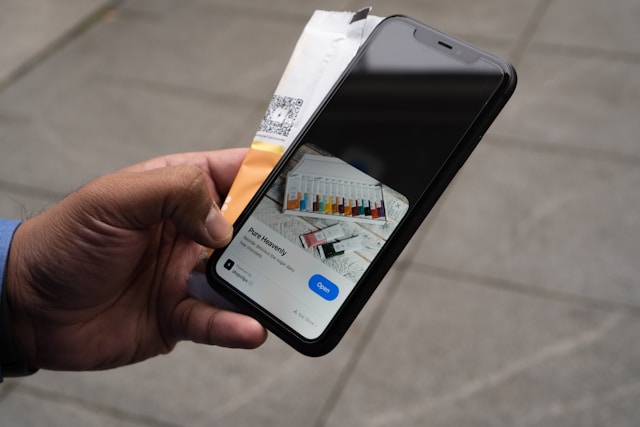
Visit any ecommerce store today, and product pages blur together.
Hero image, thumbnail gallery, bullet points, reviews. Everyone has the same template because everyone's using the same Shopify themes and best practices from 2018.
The fundamental problem: Static images can't show what actually matters.
Shoppers can't visualize themselves using the product, so they bounce. Or worse, they buy, get disappointed, and return it.
How Shoppable Video Solves It…
Video shows products in use. Not just "what it is" but "what it's like to own this."
A woman wearing the dress at the office. A traveler packing a suitcase for a weekend trip. A parent using the baby carrier while cooking dinner.
True Classic, a men's apparel brand, deployed shoppable video across 700+ product pages. Instead of static photos of t-shirts, they show fit on different body types, fabric stretch during movement, and how the clothes look after washing.
Visitors watch an average of 2.7 videos per session with a 70% completion rate.
Customer acquisition costs have increased 60% over the past five years.
Meta CPMs are up, iOS privacy changes killed targeting precision, and every competitor is bidding on the same keywords.
The brutal reality:
To acquire one customer at 2.5% CVR, you're paying to drive ~40 visitors. If you're spending $1.50 per click, that's $60 in ad spend per customer acquired.
You can't grow by simply brute force spending more on ads anymore. You have to convert more of the traffic you're already paying for.
How Shoppable Video Solves It…
Video-engaged visitors convert at 2-3X higher rates than non-viewers. If you can lift your conversion rate from 2.5% to 5% with video, you've just cut your effective CAC in half.
The returns bonus: Video also reduces return rates by 40% because shoppers know exactly what they're getting. Returns cost $12-20 per item in logistics alone, not counting lost revenue and damaged customer relationships.
Preventing returns protects the customers you worked so hard to acquire.
Dr. Squatch achieved a 9.9% conversion rate for video-engaged shoppers compared to their 3.2% baseline. Applied across their traffic, that lift generated over $750,000 in attributed revenue.
Nomad the Label achieved a 16% AOV increase and a 430X ROI with Videowise. Their story widget alone drove 60% of total video revenue.
75% of video views happen on mobile devices. Your customers live on their phones. They expect their video content to be:
When they land on your mobile product page and see five static images in a horizontal carousel, it feels dated and disorienting.
Not "bad" exactly, but not native to how they consume content everywhere else.
How Shoppable Video Solves This…
Shoppable video matches the content format your customers already prefer. Vertical videos, swipeable stories, and product tags that appear when items are shown.
And because humans process video 60,000X faster than text, you have a better shot at holding mobile shoppers before they bounce.
92% of consumers trust peer recommendations over brand messaging. First-time DTC shoppers are skeptical since they can't touch the product, may have never heard of your brand, and are skeptical thanks to an internet full of dropshippers hawking commoditized goods.
Text reviews help, but they're easy to fake. Star ratings mean nothing when every mediocre product has 4.7 stars from "verified" buyers.
How Shoppable Video Solves This…
Video testimonials are more authentic.
When a real customer shows the product in their home, talks about specific benefits, and demonstrates results, it becomes credible social proof.
User-generated content (UGC) like this is particularly powerful. When shoppers see someone like them using the product successfully, they can visualize themselves with it. That visualization is the key to overcoming purchase hesitation.
The UGC advantage: UGC video content is 8.7X more effective than branded content. Shoppers trust real people showing real results over branded ads. Learn more on how to perform with UGC videos.
ALPAKA uses creator UGC showing bags and gear in real-world travel scenarios.
A/B testing video carousel placement under Add to Cart delivered 7.8% CVR increase and $334K versus $311K revenue, with peak conversion rates reaching 12% on best-performing days.
While customers expect rich, engaging content (video, interactive elements, animations), they also demand near-instant page loads.
A 1-second delay in page load time reduces conversions by 7%, and 53% of mobile users abandon sites that take longer than 3 seconds to load.
Unfortunately, traditional video implementations kill site speed.
Most brands face an impossible choice: engaging content or site performance. Pick one.
How Shoppable Video Solves This…
This is where platform choice matters critically.
Generic video platforms (YouTube embeds, Vimeo players, self-hosted files) weren't built for ecommerce performance requirements.
Commerce-specific platforms use techniques that eliminate the trade-off:
When done right, you get rich video experiences with near-zero impact on page speed.
Not every business needs shoppable video equally. Here's how to assess fit:
Strongest ROI scenarios:
Still beneficial (but less critical):
The reality check: If your customers research before buying (and they do for purchases over $30), video helps them research more effectively on your site instead of leaving to Google or Amazon.
Shoppable video works across every vertical, but execution varies dramatically.
A beauty brand demonstrating shade matching needs different content than a furniture brand illustrating room fit and styling.
Let's break down what works best by industry with tactical recommendations from brands doing it successfully.
Fit uncertainty drives 30-40% return rates in apparel. Customers can't judge fabric drape, texture, or movement from static photos.
Every return costs $12-20 in logistics plus lost revenue.
Try-on videos showing fit across body types
Include specific measurements. "Sarah is 5'4", 135 lbs, wearing size Small." Show movement tests like walking, sitting, bending.
Demonstrate fabric behavior: does it wrinkle? stretch? cling?
Styling videos
One item styled multiple ways increases perceived value. "Dress up vs dress down" transformations trigger purchase intent when shoppers see styling they hadn't imagined.
Live shopping for community-driven brands
Tibi runs weekly "Style Class" episodes directly on their site, combining education with real-time purchasing. Over their 27 episodes they generated $2.8M in direct sales.
A four-week series on their Creative Pragmatist collection reached 7,600 viewers.
The strategy: maintain editorial depth and community engagement while layering in commerce organically. Customers can shop during live shows and through recorded replays.
Repurposing ad creatives for owned channels
Wonderskin built a production engine where winning ad creatives became shoppable on-site experiences. They source creator videos through Insense, test in paid social, then push top performers to PDPs and collections as shoppable content.
This strategy delivered 26% CVR boost in their US store (11.7% in EU), generating $1.1M in engagement value (US) and $600K (EU).
Single PDP carousels influenced $1.7M in revenue (US).
Before/after transformations
Time-lapse application for makeup. Results over time for skincare (day 1, week 2, week 4). Real customer testimonials. Slightly imperfect customer videos outperform professional production.
Beautifect generated $2M in video-driven revenue over 10 months at up to 11% CVR. Their top-performing video carousel widget alone drove $600K, with shoppers watching an average of 24 videos per visit.
Technical products need demonstration of real-world performance. Shoppers want to see products in action including sound quality, durability, and actual use cases.
Strategic placement: Skullcandy places UGC carousels directly under the "Add to Cart" button on PDPs, reinforcing purchase confidence at the moment of decision.
This placement, combined with automated Instagram feeds on the homepage, delivered a 7.9% RPS increase.
A single carousel generated $120,000 in post-video revenue in under a month, adding 265 hours of time on site.
Scale and size are nearly impossible to judge from photos. Customers often need to see products in real rooms, in context.
Benefits need demonstration because claims without proof breed skepticism, while usage instructions are critical for product effectiveness.
Trust-building is especially paramount in a category full of snake oil.
Ayu Cosmetics uses founder recommendations, application tutorials, and UGC on PDPs to demonstrate techniques that text can't convey.
Shoppers watch an average of 5 videos per visit, with 21.67% of viewers converting at 12% average CVR (peaks of 20%), generating $661K in revenue.
Durability, capacity, and real-world performance matter more than aesthetics. Shoppers need to see how products actually perform.
Travelpro manages 10 Shopify websites from one platform, deploying a consistent video strategy across all properties. Result: $269,000 in attributed revenue at 7.9% average CVR.
Taste and smell can't be conveyed in photos, while usage demonstrations drive inspiration and trial interest.
Regardless of industry, effective shoppable videos:
Not all shoppable video platforms are built the same.
Some were designed for generic video hosting with commerce features bolted on later. Others focus exclusively on livestreaming. And a select few were built from the ground up specifically for e-commerce conversion, to help you make the best of your product video strategy.
Choosing the wrong platform means either sacrificing site performance, paying for features you don't need, or missing the analytics that prove ROI. We've prepared for you a digestable list of the 12 best shoppable video platforms in 2026.
This section will help you avoid those pitfalls.
Before comparing specific platforms, understand the five non-negotiable requirements that separate commerce-first solutions from generic video tools.
1. Commerce-Specific Features
Your platform needs more than the ability to play video. It must be built for video commerce:
Generic video platforms like Vimeo and Wistia were built for marketing teams who measure views and engagement. But Ecommerce brands need to measure revenue.
If your platform can't connect video performance to actual sales, you're flying blind.
2. Site Performance Protection
This is where most platforms fail. Adding video shouldn't tank your conversion rate by slowing down your site.
Look for:
Why this matters: A 1-second delay in page load reduces conversions by 7%. Adding video should increase conversions, not destroy site performance.
3. Full-Funnel Analytics & Attribution
"Engagement" doesn't pay the bills. Attributable revenue lift does.
Your platform must track 4 things:
You need to walk into your CFO's office and say: "This video generated $47,000 in revenue last month at a 42X ROI."
4. Deep Ecommerce Integration (Especially Shopify)
If a majority of your revenue comes from Shopify, you need Shopify-native integration:
Manual product tagging doesn't scale. When you have 700+ SKUs like True Classic, you need automation.
Ask yourself: Do I want my team to have to manually update product tags every time inventory changes?
5. Scale & Automation Features
To grow from a $10M to a $100M brand requires processes and systems that scale. That means your shoppable video platform needs to grow with you.
Without automation, video management becomes a full-time job. Platforms with smart automation let you focus on strategy instead of manual tasks.
The shoppable video market breaks into three distinct categories. Understanding which category fits your needs will save you months of trial and error.
Built specifically for ecommerce. Shoppable features are core, not an afterthought.
Examples: Videowise, Tolstoy, Firework (video commerce tier)
Best for: Mid-market to enterprise ecommerce brands, Shopify-native stores, brands prioritizing conversion over generic engagement
Pros:
Cons:
Built for marketing teams hosting videos. Added commerce features later to stay competitive.
Examples: Vimeo (added shoppable features 2023), Wistia (limited commerce integrations), YouTube (annotations, no native tags)
Best for: Brands prioritizing video hosting and management over shoppable functionality, companies with existing contracts
Pros:
Cons:
When to consider these: If you're primarily creating brand awareness content (not direct-response) and already pay for Vimeo Enterprise, it might make sense to use their shoppable features.
But if conversion is your priority, commerce-first platforms will outperform.
Built for live shopping events. On-demand shoppable video is secondary.
Examples: Bambuser (livestream pioneer), Firework (enterprise live commerce)
Best for: Brands prioritizing livestream shopping events, large enterprise budgets, broadcast-quality productions
Pros:
Cons:
When to consider these: If livestream shopping is your primary strategy and you have the budget for enterprise tools. But most mid-market brands get better ROI from on-demand shoppable video first, then add live shopping as they scale.
Here's how the leading platforms stack up across the features that actually matter for ecommerce conversion:
Native Shopify app or embed codes? Product catalog sync automated or manual? Pricing and inventory updates automatic? Compatible with current theme and page builder?
JavaScript file size? Lazy loading implementation? Mobile optimization approach? Lighthouse score impact measurable in trial?
Revenue tracking per video? Comparison metrics (video viewers versus non-viewers)? Conversion funnel visibility (view → click → cart → purchase)? Google Analytics integration?
Bulk deployment across multiple pages simultaneously? UGC import automation from social platforms? Video hosting limits or overage charges? Multi-store support if operating multiple Shopify instances?
What support tier is included in pricing? Dedicated account manager availability? Average response time? Implementation assistance provided?
Implementation Expertise
Videowise customers get dedicated account manager support for setup, bulk deployment assistance, and optimization strategy. Our new customers are typically generating results within 1-2 weeks.

Here are 5 shoppable video tactics that help move the needle and improve the bottom line:
1.) Repurpose winning ad creatives as on-site shoppable content.
Wonderskin sources creator videos through Insense, tests in paid social, then deploys top performers to PDPs as shoppable experiences.
Result: 26% CVR boost (US), $1.1M engagement value, $1.7M influenced revenue
2.) Use different videos to eliminate specific purchase barriers:
3.) Placement location impacts performance as much as content quality.
Skullcandy tested a UGC carousel directly under the Add to Cart button (versus the standard above-fold hero).
Tactical single carousel placement = $120,000 attributed revenue in under one month.
4.) Mobile optimization = vertical format (9:16) + large tappable tags + TikTok-native browsing feel.
Not desktop video squeezed into mobile dimensions. Most digital traffic is mobile native these days. Make sure your shoppable video content is mobile-optimized first.
5.) Lazy loading preserves performance.
True Classic went live with 700+ pages deployed, zero site speed degradation. Videos load on scroll, not initial page load.
6.) Track cohort comparison from day one:
Attribute results by video viewers versus non-viewers in terms of CVR, AOV, time-on-site, and return rate. Without comparison groups, you can't prove incremental impact.
Complete ROI calculation:
ROI = (Revenue from Video Viewers - Platform Cost - Content Production) / (Platform Cost + Content Production)
TIP: Don't undercount content costs. Manual tagging, rights management, and seasonal updates are hidden time drains. Automation reduces these by about 80%.
Talk to a Videowise expert. During a free demonstration, we'll show you:
✓ Videowise deployed on your actual products
✓ Expected conversion rate impact based on your traffic and category
✓ Custom implementation timeline for your catalog
✓ ROI projection specific to your business metrics
Shoppable video is interactive video content that allows viewers to purchase products directly within the video experience by clicking on products, viewing details, and adding items to cart without interrupting the video.
Not with platforms built for ecommerce performance. Commerce-specific platforms use lazy loading (videos load only when scrolled into view), adaptive streaming (adjusts to connection speed), and file compression. Test before committing. Run page speed tests (Google Lighthouse, PageSpeed Insights) to verify zero performance impact.
Products are tagged to a video, and viewers can tap to explore details and add items to the cart while the video continues in the background or pauses based on preference.
No. Most brands start by repurposing existing content from TikTok, Instagram, YouTube, and customer posts. Existing assets typically provide 6-12 months of initial deployment runway. Content creation gets easier over time as you identify gaps based on performance data.
Statistical significance for A/B testing typically requires 2-3 weeks, depending on traffic volume. Most brands see positive ROI within 60 days.
Why Shoppable Video Matters for Ecommerce
The Ecommerce Pain Points Shoppable Video Solves
When Shoppable Video Works Best
Shoppable Video Examples by Industry & Use Case
Shoppable Video Platforms: Comparison & Selection Guide
Shoppable Video Tactics That Lift Performance