.png)
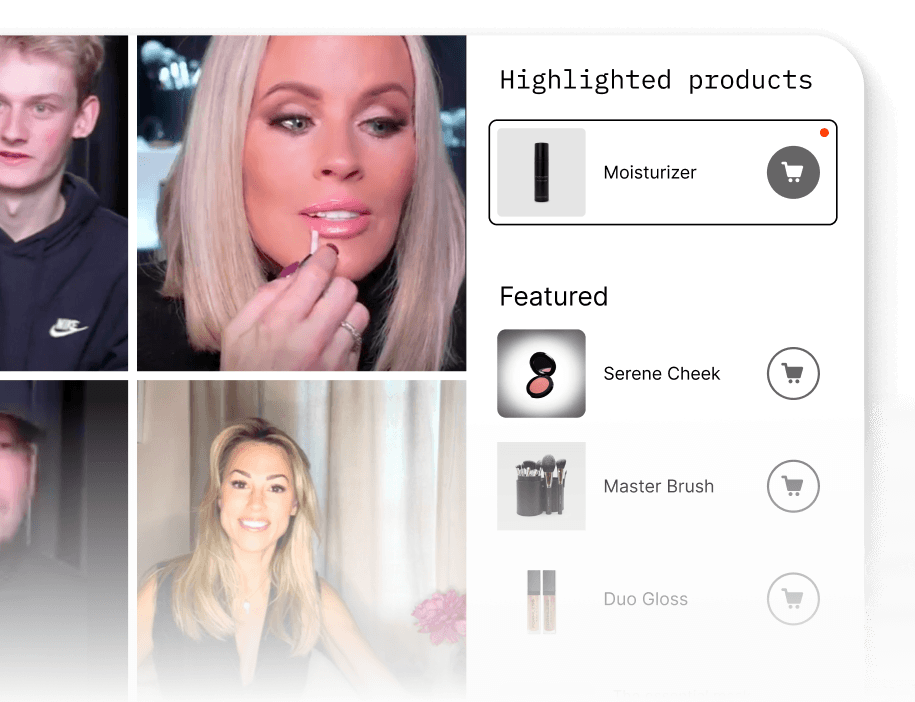
Live video commerce combines real-time streaming with instant purchasing. A host demonstrates products during a broadcast while viewers ask questions in chat, click product tags, and add items to cart, all without having to navigate to a different site or checkout area.
This differs from recorded shoppable video in one critical way: real-time interaction.
Viewers get answers to specific questions about fit, functionality, or suitability directly. The host can respond to "Does this work for sensitive skin?" or "Will this fit someone 5'10"?" in the moment, building confidence that static product pages cannot replicate.
Live shopping eliminates the friction between "I want this" and purchasing. When a viewer sees a product they like, product tags appear on screen with pricing and variants. One click adds the items to cart. The entire experience happens within the video, without redirects or context-switching.
Unlike livestream-only platforms that send buyers off-site, commerce-first live shopping platforms keep the checkout experience native to the ecommerce store.
This matters because every additional step in the purchase flow reduces conversion by 7-10%.
Ecommerce baseline conversion rates sit at 2-3% across most categories vs recorded shoppable video lifts of 5-8%.
Live shopping takes it further by adding elements that recorded video cannot: real-time interaction, unscripted authenticity, and urgency created by scarcity and community momentum.
A live broadcast stacks social proof and FOMO on top of authenticity and illustration:
It's a fundamentally different psychology.
Live shopping's primary advantage over recorded video is answerability. When a shopper has a specific question about fit, functionality, or suitability, they can get it answered live rather than having to search for it in a video carousel.
Tibi documented this dynamic across 27 weekly episodes.
Their audience asked specific questions in chat:
"Does this dress show sweat marks?"
"Does this shirt shrink in the wash?"
"Can I wear this to [specific context]?"
The host answered in real-time while continuing to demonstrate. This interaction creates confidence that even the best pre-recorded content cannot replicate.
The conversion lift comes from objection resolution at the moment of peak interest. A viewer watches a blazer, thinks "Does this work for my shoulder width?", types it into the chat, gets an immediate answer, and purchases.
No hesitation window. No delay where interest cools.
Tibi's $2.8M over 27 episodes shows this works at scale. Weekly cadence built repeat audiences. Viewers returned because live events provided direct access to the person making the products.
Recorded video can create urgency through countdown timers and limited-time codes. Live shopping creates natural urgency via real-time scarcity and community momentum.
During a live broadcast, viewers watch product stock depleting in real-time. They see other customers buying in chat. They know the event ends at a specific time. These create genuine momentum and purchase intent. The urgency emerges from actual capacity constraints and event timing.
This scarcity and urgency accelerate purchase decisions. Shoppers who might research a recorded video for days will purchase during a live event because they sense time sensitivity.
They also see peer validation in real-time (other people buying, people saying positive things in chat), which reduces decision anxiety.
Live shopping, by definition, includes moments that cannot be scripted or re-edited. A host struggles with a product demonstration. A customer asks a question that the host hadn't anticipated. Someone in chat points out a flaw. The host addresses it honestly.
These unscripted moments build credibility that perfectly polished content can't. Customers tend to trust authenticity more than perfection, especially when making purchase decisions.
Compare this to recorded shoppable video, which is edited, curated, and controlled. Polished and professional, but clearly produced. Live shopping feels less produced even when technically professional. The unscripted element signals honesty.
During a live broadcast, hundreds or thousands of viewers are watching simultaneously.
The chat becomes a social experience. Customers trade sizing tips, recommend colors, and share excitement. This peer-to-peer element is where live shopping resembles social commerce platforms but stays on your owned channel.
WARC research found that 72% of live shopping participants report feeling more connected to the brand afterward. This connection drives repeat purchases and word-of-mouth.
This effect compounds with frequency. Tibi's weekly format built a community of repeat viewers who felt like insiders. They attended weekly to see new pieces and reconnect with peers they saw in previous episodes' chats. This converted casual customers into loyal audiences.
One 60-minute live event generates multiple revenue streams and content assets.
A live broadcast generates:
Live shopping works as an acquisition channel precisely because it feels different from traditional ecommerce and advertising.
Gen Z shoppers already expect video from TikTok, Instagram, and YouTube. But they experience live shopping rarely from DTC brands. This novelty creates differentiation and shareability.
When a customer attends a live shopping event and likes the experience, they tell friends. They share clips. They invite others to the next one. This word-of-mouth activation is lower-friction than traditional advertising because it's a peer recommendation.
For brands struggling with rising CAC in saturated categories, live shopping offers a differentiation hook. Being "the brand that does weekly live shopping" becomes a brand attribute, especially if executed well.

Live shopping execution isn't complex, but it naturally requires more planning than recording a product video. The difference is managing real-time interaction and building audience anticipation.
Format choice determines everything downstream: production complexity, frequency, team requirements, and which products fit the narrative.
Educational/Tutorial Format
Works best for products where technique, application, or assembly matters.
These formats run 30-60 minutes and work on a weekly cadence because the educational value compounds (customers return to learn new techniques). Beauty and home goods brands gravitate here because the format matches the education that drives their purchase decision.
Influencer/Expert Takeover
Influencer features bring outside credibility.
A brand partners with a beauty influencer who demonstrates products through her lens, or an athlete showcases gear in authentic use contexts.
Format is typically 45-90 minutes, less frequent (seasonal or quarterly), and works across categories. The external expert brings audience and authenticity that founder-hosted content alone cannot.
Product Launch Events
Product drops showcase new collections with real-time selling, like a fashion brand launching a capsule collection with a 60-90 minute live showcase.
Limited-time discounts or "live-only" offers create urgency here. This format works seasonally and is product-launch-driven, so frequency varies by company.
Apparel, beauty, and equipment brands use this heavily.
Community Q&A
FAQ-type events showcase the founder or leadership directly answering customer questions live.
Minimal production, maximum transparency.
This format is usually 45-60 minutes and builds trust through unfiltered conversation. Premium brands and mission-driven companies use this to strengthen loyalty.
Behind-the-Scenes/Storytelling
Brand narrative or "behind-the-scenes" live shopping events show manufacturing, sourcing, or design process.
Sustainable brands show supply chain while artisanal brands show craftsmanship. This format justifies premium pricing through transparency. Consider a 30-45 minute, episodic series here.
Format choice inevitably cascades to production requirements:
Choose a format based on what your team can sustainably execute.
Live shopping works when execution is repeatable. Tibi's 27-episode run across 27 weeks (roughly weekly cadence) only happened because the planning and promotion rhythm became systematized.
8-12 weeks before first event: Decide on format and frequency. If weekly, you're committing to 52 episodes per year. That's significant resourcing.
If seasonal, plan which seasons and which products. Assess team capacity honestly.
6-8 weeks before: If using influencers or external talent, start outreach now. If internal, brief the host on narrative and key talking points. Select products to feature. For educational formats, develop a curriculum (what will you teach across the series?).
4-6 weeks before: Create production assets (graphics, product shots, demo videos) if needed. Write event descriptions and promotional copy. Finalize any talent agreements.
2-3 weeks before: Launch email campaign driving RSVP. Segment audience: past video engagers, high-LTV customers, email subscribers. Offer an incentive to attend (exclusive discount, first access to new product). Build anticipation through teaser posts on owned social.
1 week before: Final promotion push. Reminder email (open rates spike 3-5 days before). Social media teasers. Send an SMS to your highest-engagement segment. Confirm host availability, test all technical elements (camera, audio, internet speed, product tags in system).
2-3 days before: Final confirmation emails. "Happening [DATE] at [TIME], mark your calendar" with a direct link to the event.
Day of: 30-minute pre-show for host and operations team. Technical verification. Product inventory confirmed. Test product tagging in live environment.
Immediately post-event: Publish your shoppable replay on-site. Follow up with non-attendees within 24 hours: "Missed the live? Replay is live now + exclusive 24-hour discount code." This drives replay traffic when engagement is highest.
Production quality doesn't require significant investment.
In-studio means controlled lighting, consistent background, and professional appearance. It also requires space rental or a dedicated internal space, good lighting setup, and camera equipment. Best for brands wanting a consistent aesthetic across episodes. Highest production value but most expensive.
At-home/minimal means using a smartphone camera, natural lighting, and a simple backdrop. Highest authenticity, lowest barrier. Works for founder-hosted educational format or expert takeovers. Requires nothing except a team member comfortable on camera and an internet connection.
Field/on-location means demonstrating products in real use contexts. Hiking gear tested while hiking, luggage packed for actual travel, tools used on an actual project. Highest authenticity for equipment and lifestyle brands, but also the most logistically complex. Requires crew, equipment, and real-world access.
Team requirements vary by format. Minimum viable team: host (founder or team member comfortable on camera) + operations person (manages product tags, answers chat, handles tech issues). Host delivers. Operations makes sure everything works. For early events, this is often the founder + one team member doing both roles.
As frequency increases, add a dedicated producer (manages timing, coordinates runsheet) and a content person (plans narrative, coordinates assets ahead of time).
Budget reality: most brands start DIY. That means founder + smartphone + one team member handling ops.
This works until weekly cadence strains the team, then invest in production support.
Tibi reached 7,600 viewers in one 4-week series of weekly episodes built via repeat attendance, as opposed to one-off viewers.
The difference is significant: repeat viewers might attend 4-12 times per year, creating a predictable audience and revenue.
But developing repeat attendance requires a consistent promotional rhythm.
Email drives attendance. 4-6 weeks before, email your key list segments, including:
Message: "We're hosting weekly Style Classes! Join our community..." Leverage an RSVP drive with a calendar link and exclusive early-access discount for attendees.
Repeat email 2 weeks before, 1 week before, and 2 days before with a reminder message and direct event link.
SMS to the highest-intent segment shortly before the event, such as 3 days before and 24 hours before. Include a brief message with event details and a link. Use text strategically because SMS open rates tend to far exceed email.
Paid social 3-4 weeks before targeting past video engagers, past purchasers, and lookalikes. Build audience awareness with messaging that teases the event, but doesn't oversell (educational angle performs better than "exclusive sale").
Organic social creates ongoing awareness:
Organic builds anticipation without ad spend.
Site homepage features event 1-2 weeks before. Hero banner with event date/time and signup link. Keep this prominent until the event concludes.
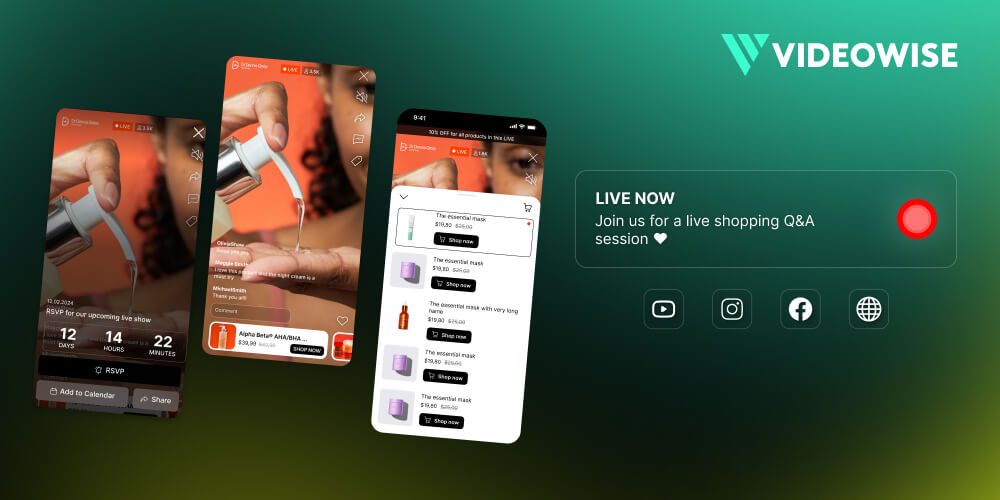
Live shopping execution differs dramatically by category.
What works for beauty (real-time shade matching) fails for equipment (durability testing requires different setup). What works for fashion (emotional storytelling) feels forced in wellness (expert credibility matters more than narrative).
Here's how to optimize live shopping by category.
Live shopping solves beauty's core barrier: real-time shade matching and custom answers. When a potential customer asks, "Will this work for my undertone?" during a live event, and the host matches it live on camera, that's conversion power.
Event structure: Tutorial + live Q&A in chat. Host (makeup artist, beauty influencer, or brand founder) demonstrates a technique - foundation application, eyeshadow blending, lip color pairing. While demonstrating, customers ask questions in real-time. "Does this shade oxidize?" "Will this work on oily skin?" "What brush do you use for this?" The host answers while continuing to apply or moving to the next product.
Real-time dynamics: This isn't a prepared Q&A section at the end. It's integrated throughout. Host applies foundation, someone asks about undertones, host immediately shows on another skin tone. Host blends eyeshadow, someone asks about brush technique, host pauses and demonstrates.
Product tagging in chat moments: When a customer asks about a specific product and the host addresses it, that's the moment to tag. Conversion is highest in these moments of live problem-solving.
Frequency: Weekly works best for skincare and beauty brands. Customers develop routine habits around attending. They come back expecting new techniques, new color releases, or recommendations for seasonal looks.
Live shopping for fashion works because it combines visual movement (showing fit and drape) with real-time fit questions. A customer watching a dress can ask, "Will this show a VPL?" or "Does this ride up when you sit?" in chat, and the host demonstrates in real-time.
Event structure: Show new collection with styling context. Models wear pieces from a new launch. Host explains design inspiration and styling ideas. But the value is in the chat. Customers ask about fit, sizing, fabric, care. Host answers by showing directly. "Does this run small?" - host tries a smaller size live, compares. "Can I wear this to [occasion]?" - host styles it with different pieces and shows it on camera.
Real-time fashion problem solving: Recorded fashion video shows styling ideas. Live fashion shopping shows problem-solving. Customers bring their specific concerns (not your pre-planned scenarios) and see resolution in real-time. This removes hesitation.
Product tagging around objection moments: When a customer asks if a blazer works for narrow shoulders, and the host shows it fitting well on a model with narrow shoulders, tag it immediately. The objection has just been resolved in real-time. Conversion is highest right then.
Frequency: Tibi proved weekly is sustainable for clothing and apparel brands. Their "Style Class" format built loyal audiences. Repeat viewers knew they could attend weekly to see new pieces and get styling inspiration from the community. This frequency builds habit and FOMO (if you miss one week, you miss new pieces).
Live shopping for equipment works because it enables real-world problem-solving. A customer considering a backpack can ask, "Will this fit my laptop and water bottle?" and the host actually packs it live while explaining.
Event structure: Demo + real-world problem-solving. Host uses products in realistic scenarios. For travel gear: "I'm packing for a weekend trip. Here's what fits." But the power is answering variations. Customer asks, "What if I need space for a drone?" Host repacks and shows. "Does this fit under airplane seats?" Host demonstrates with actual measurement. Each answer generates purchase momentum in chat.
Real-time logistics problem-solving: Recorded equipment video shows features. Live equipment shopping shows real-world product demonstrations at work. Your customer brings their specific use case and sees a resolution live.
Product tagging in problem-solving moments: When a customer asks "Will this work for [specific use case]?" and you demonstrate that it does, that's the conversion moment. Tag immediately.
Frequency: Seasonal or product-launch driven makes sense. New collection launch warrants a live event. Peak season (summer for outdoor gear, holidays for travel gear) warrants a frequency increase. Off-season can be monthly or quarterly.
Live shopping doesn't necessarily end with the broadcast. The post-event extends revenue opportunities.
A 60-minute live event can generate as much or more revenue than live revenue via these tactics:
Immediate phase (2-7 days post-event)
Publish shoppable replay on-site immediately. Email non-attendees within 24 hours: "Missed the live? Watch the full replay + get 48-hour exclusive discount code." This segment (non-attendees) is often larger than the live audience.
Send SMS to attendees: "Replay is live. Watch again or share with friends." Attendees sometimes watch again (caught something they missed, want to purchase additional items, or share with friends).
Medium-term phase (2-8 weeks)
Create 15-30 second clips from the replay. Make each clip shoppable with direct add-to-cart buttons for featured products.
Repurpose clips to TikTok, Instagram Reels, YouTube Shorts. These clips drive traffic back to the on-site shoppable replay where the full event lives. The clip performs social function (reach, viral potential). The replay performs conversion function (full education, complete purchase journey).
Long-term phase (months+)
Organize replays into a searchable library. "Spring Collection," "How-to Tutorials," "Product Comparisons," "Customer Favorites." This is the infrastructure that drives sustained revenue from live events long after they end.
Building an evergreen asset base compounds live shopping ROI over time.
Your video content hub is what transforms individual live events into a compounding, always-on sales asset.
Platform choice for live shopping differs from recorded shoppable video because live shopping requires real-time interaction infrastructure, in contrast to typical streaming capability.
Two platform categories exist, and they optimize for different outcomes.
Commerce-first platforms (like Videowise) are built for ecommerce with live shopping as a core function.
Live streaming quality is sufficient for a professional broadcast. The architecture also prioritizes on-site checkout + real-time product tagging, and chat infrastructure is built in.
Product inventory syncs automatically, so tags always show current stock and pricing. Replay capability is also automatic. When the event ends, the replay goes live immediately. Integration with Shopify is native, so no developer setup is required.
Livestream-first platforms (like Firework, Bambuser, and YouTube) prioritize broadcast quality.
They handle 10,000+ concurrent viewers and multistream setups. But checkout typically requires viewers to leave the stream to access your ecommerce store.
This friction matters for live shopping because real-time urgency evaporates the moment someone leaves the video. Replays are available but require separate setup. Chat is full-featured but not integrated with your product catalog, meaning hosts have to manually tag products.
Decision framework:
Live shopping has 6 key requirements to be successfully executed.
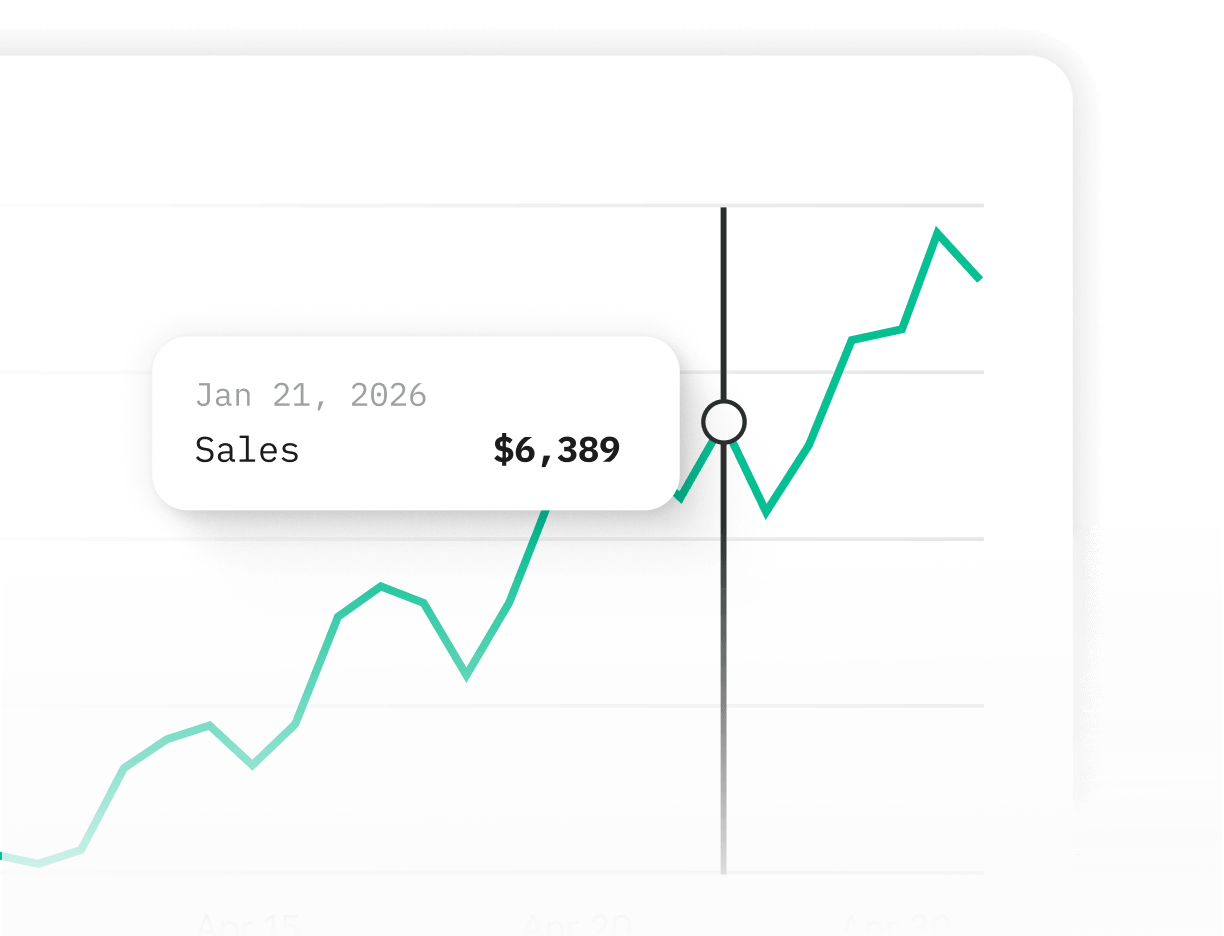
Vanity measures like total viewers are nice, but the goal is to isolate the live event's conversion premium and calculate whether continued investment is justified.
These are the metrics that measure the live shopping moment itself, where the conversion advantage exists.
Replay and clip content extend reach, but they're secondary to the live event itself.
Live shopping revenue hierarchy:
Each layer has lower revenue than the layer above. This is normal and expected. The live event is where the conversion premium exists because of real-time interaction, urgency, and community momentum. Replay captures people who couldn't attend live, but without the real-time element. Don't expect replay to match live revenue. If it does, your live event likely underperformed (either low attendance or low engagement).
Formula: ROI = (Live revenue + Replay revenue + Downstream email/SMS revenue) / (Production costs + Platform costs)
Real example (Tibi-based):
(Note: Tibi's actual costs may differ, but this illustrates the scale possible.)
The most important analysis: did live shopping viewers convert higher than baseline?
Compare conversion rates, AOV, and repeat purchase rate between cohorts. Cohort A should show 2-3X higher CVR if the live event is working.
This comparison isolates the live shopping effect. Without it, you can't distinguish between "the live event drove results" vs "high-intent customers self-selected into attending live events."
Bonus insight: Also track Cohort C (people who missed the live but watched the replay). Their CVR should be notably lower than Cohort A but higher than Cohort B. This will prove if the live event premium exists.
Live shopping creates attribution challenges:
Solution: Use first-party video analytics with pixel-level tracking.
Commerce-first platforms like Videowise handle this automatically. The platform tags viewers during the broadcast and tracks them through conversion. You get revenue attribution per event, per viewer, per product.
Don't rely on last-touch attribution alone (misses important touchpoints). Use multi-touch models if available, or acknowledge that your attribution is underestimating video's impact.
Start with recorded shoppable video if live feels intimidating. Recorded content eliminates real-time pressure and makes editing/refinement easier. Once your team is comfortable with video workflows and you understand what your audience engages with, layer in live. The two complement each other (live drives urgency and community, recorded provides scalable evergreen content).
This depends on your brand or category, but in general, start with monthly. If that works, move to bi-weekly. If you reach sustainable operations, try weekly. Tibi proved weekly is achievable (27 episodes/27 weeks), but they had clear format consistency and a repeat audience. Frequency should match your team's capacity and your content supply. One mediocre event per week is worse than one excellent event per month.
Yes, with tradeoffs. The founder or team member can host, and another can handle operations (managing chat, product tags, answering questions, handling tech). You'll need a cleaner runsheet and a tighter process, but it's doable.
This depends on AOV and conversion lift. High-AOV categories (fashion $100+, luxury beauty $50+, equipment $150+) see faster ROI. Lower AOV needs volume. Our case study data shows live shopping works across all categories: beauty, fashion, equipment, wellness, and CPG. The format itself isn't category-specific. Your category works if your customers care about education, demonstration, and real-time interaction. Most do.
DIY for first 5-10 events. Founder + team member + smartphone. This teaches you what works for your audience before investing in production. Professional production is worth considering when you've identified what works and need to scale frequency.
Why Live Shopping Works: The Business Case
How to Plan Live Video Shopping Events
Shoppable Replays and Libraries


.jpg)
.jpg)