.jpg)

Product discovery is turning into a conversation. Shoppers now ask ChatGPT, Gemini, and Copilot things like "find me a gym backpack that fits a 16-inch laptop under $150" and expect a direct answer, not ten blue links.
For Shopify brands, AI shopping agents create two problems at once. First, your products need to be discoverable and understandable to agents you don't control. Second, when an agent sends a shopper to your store, that shopper arrives with high intent and hard questions, and your storefront has to close the sale. Most preparation advice covers the first problem and ignores the second.
This guide covers both: what AI shopping agents are, how Shopify's agentic commerce infrastructure works, and the specific catalog, content, and conversion work that gets your store ready. Including the part most feeds can't carry: video.
AI shopping agents are conversational AI assistants that help shoppers discover, compare, and buy products through natural language. Unlike a generic chatbot, a shopping agent connects to real commerce data: the product catalog, inventory, store policies, and cart actions. Shoppers can ask intent-based questions ("which serum for sensitive skin?") and complete a purchase without browsing filters or search results.
The distinction that matters is connection. A chatbot answers from general knowledge and guesses from page text. A shopping agent retrieves structured data from your store and acts on it: it searches by intent, checks availability, cites your return policy, and adds to cart. That's why the infrastructure work happening at Shopify matters more than any chat widget.
Three pieces of infrastructure landed in quick succession. Shopify published Storefront MCP, a Model Context Protocol layer that lets AI agents search products, answer policy questions, and manage carts on a store in a structured way. Shopify is rolling out agentic storefronts so eligible stores surface in AI channels like ChatGPT, Google AI Mode and Gemini, and Microsoft Copilot. And OpenAI shipped merchant and product-feed infrastructure for product discovery and checkout inside ChatGPT.
The result: AI commerce is now both an external discovery channel (agents recommending products before shoppers ever reach your site) and an onsite conversion layer (assisted buying once they arrive). The readiness question for any Shopify brand is blunt: if an AI agent had to represent your store to a shopper today, would it have enough context to do the job well?
For most brands, the answer is no. Product data is thin, policies live in scattered help docs, and the most persuasive content the brand owns, its videos and UGC, is invisible to agents because nothing connects it to products or shopper questions.
Agentic checkout also raises the stakes on availability, an AI agent can only recommend what’s in stock, so brands pair video commerce with AI inventory forecasting for Shopify to keep bestsellers buyable.
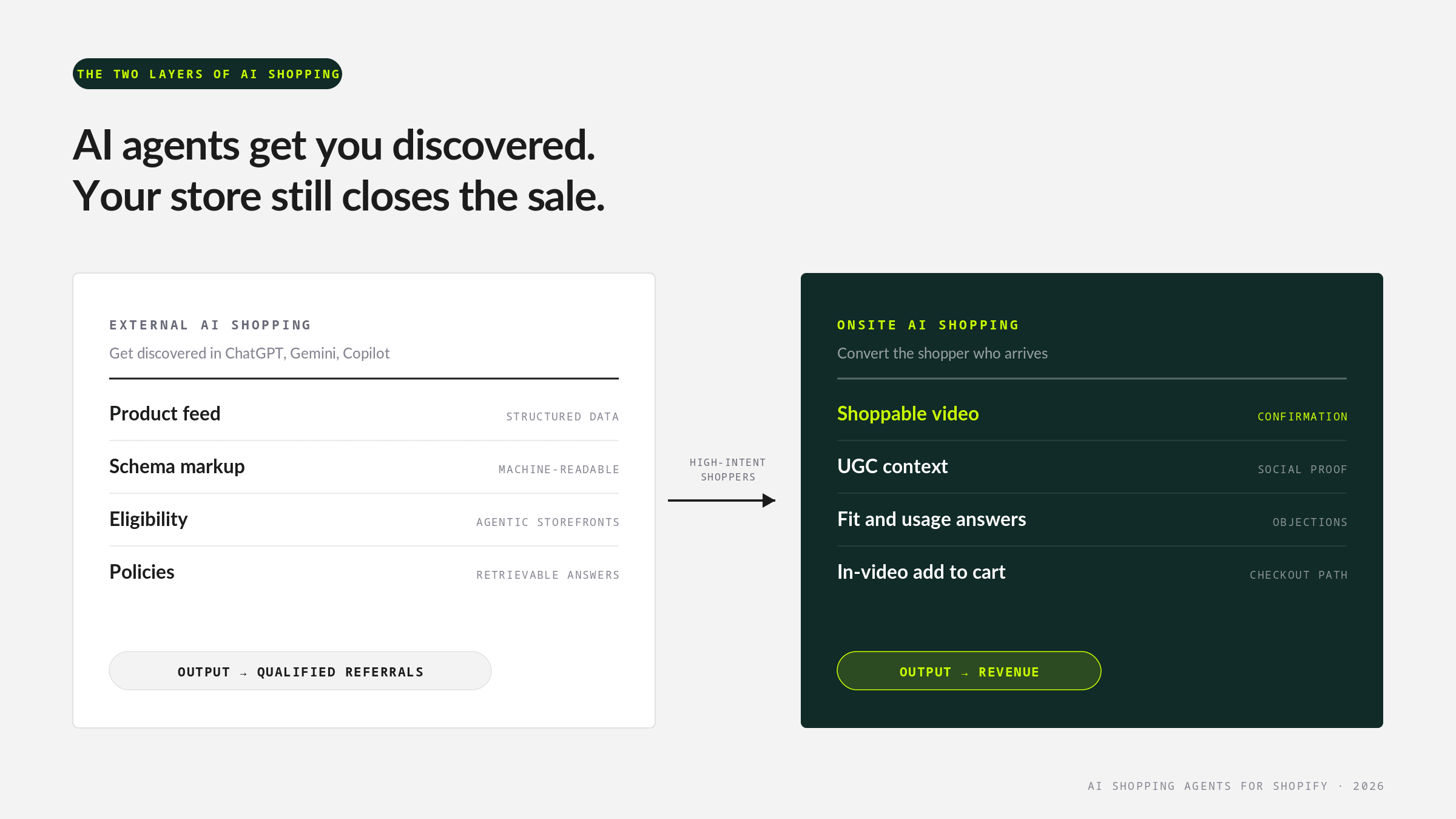
Preparation splits into two distinct jobs, and they are not interchangeable.
External AI shopping gets you found. It runs on structured product feeds, schema markup, eligibility settings, and consistent brand data. Onsite AI shopping converts the shopper who arrives. It runs on buying context: recommendations, fit and sizing answers, demonstration content, and a frictionless path to cart.
A product feed can put your catalog inside ChatGPT. It cannot answer "how does this jacket move when I walk?" That second job belongs to your store, and it's where the revenue actually happens.
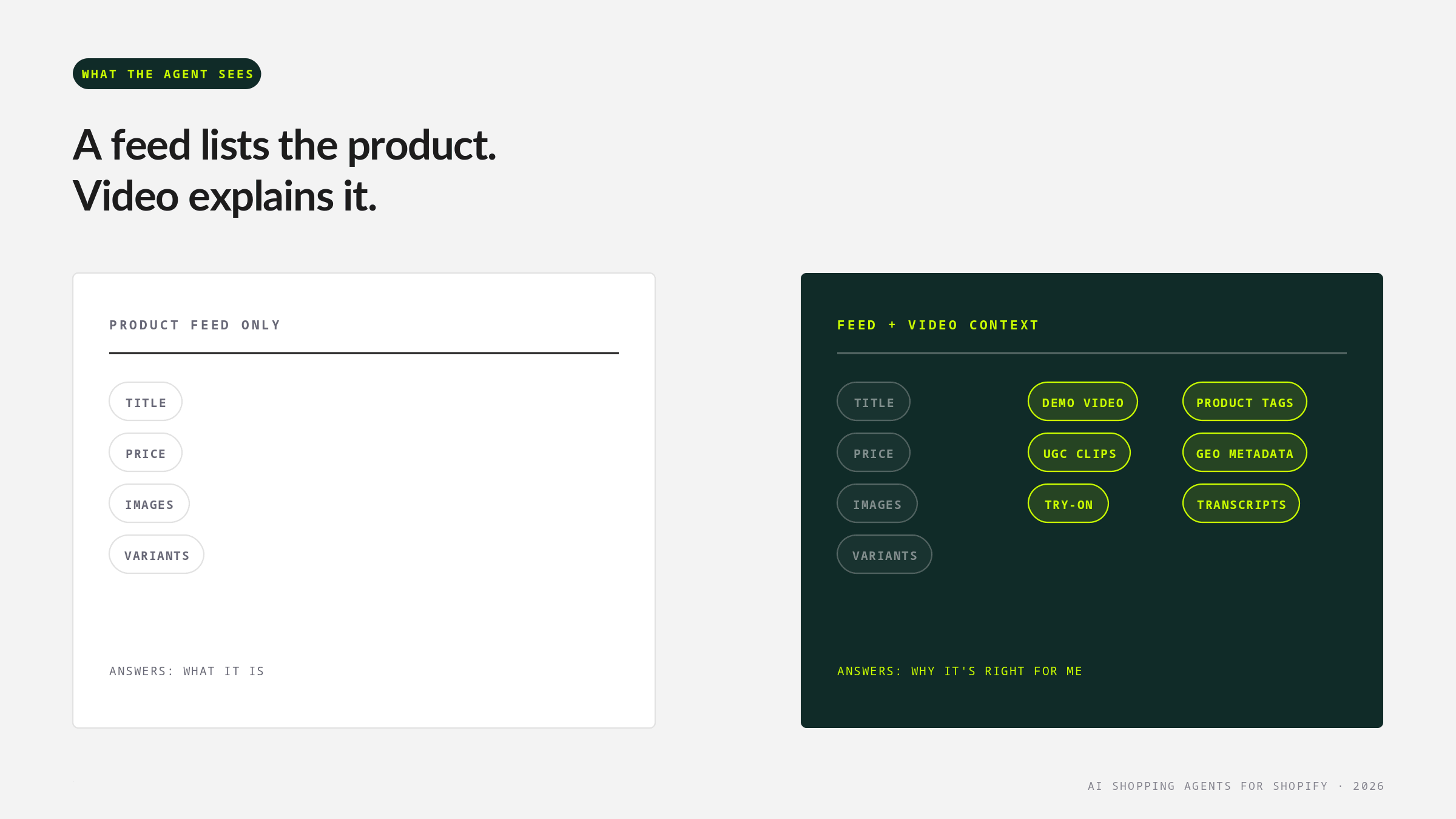
A feed carries titles, prices, variants, and images. A human sales associate carries everything else: how the fabric stretches, what the texture looks like on real skin, whether the bag actually fits under an airline seat. Shoppers ask agents exactly these questions, and most catalogs have no machine-readable answer.
This is where video stops being decoration and becomes data. A product demo answers "how does it work." A UGC clip answers "what does it look like on someone like me." A try-on video answers "how does it fit." The catch: an agent can only use that content if it's connected to products and structured for retrieval.
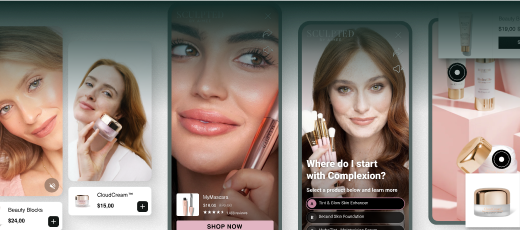
That's the layer Videowise builds. Every video in the library gets AI product tagging and object recognition, so content maps to specific SKUs. SEO and GEO metadata generation makes video content readable by search engines and AI systems instead of opaque media files. Natural language search across the library means "founder explaining the returns process" is findable as an asset. And SEO-optimized video channel pages give agents and crawlers indexable pages where product video lives with full context, not buried in a carousel. For the foundation, see our guide to video SEO strategies.
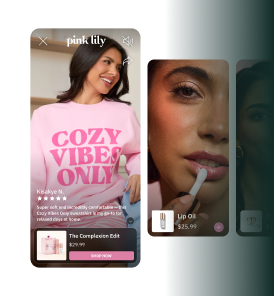
Here's the part the feed-first advice misses: most AI shopping journeys still end on your storefront. Agent-referred shoppers arrive deep in the funnel, pre-qualified by the conversation they already had. What they need is confirmation, and video is the fastest confirmation layer ecommerce has.
The numbers back this up. Sessions that engage with shoppable video convert at 9 to 17%, against a 2 to 3% ecommerce baseline, per Videowise's video commerce ROI benchmarks. True Classic converts video-engaged shoppers at 13% with a 70% completion rate. Skullcandy lifted revenue per session 7.9% in an A/B test. High-intent traffic plus high-context content is exactly the combination AI referrals reward.
Practically, that means putting shoppable video where AI-referred shoppers land: PDPs, collections, and landing pages, with product tagging and in-video add to cart so confirmation flows straight into checkout. It also means treating UGC video as a conversion asset, since authenticity is the one thing an AI-generated answer can't fake.
Skullcandy, True Classic, Hot Ones, and 5,000 other brands run video as a measured CRO channel on Videowise. Book a free demo to see what AI-ready video looks like on your store.

Run this audit across four areas, in this order:
Catalog and policy work makes agents accurate. Content and conversion work makes them profitable.
.png)
Videowise is a CRO-driven video commerce platform. It doesn't replace your product feed or schema work. It covers the three layers a feed can't, which happen to be the layers where agent-era revenue gets decided.
Agents can't watch video. They read structure: tags, transcripts, metadata, and the pages content lives on. Videowise builds that structure automatically. AI product tagging and object recognition map every video in your library to the exact SKUs it features. SEO and GEO metadata generation turns each clip into content that search engines and AI systems can parse and cite. Transcripts, AI-generated chapters, and testimonial extraction expose what's actually said and shown inside the video. And SEO-optimized video channel pages publish your library on indexable URLs, so the demo that answers "does this backpack fit under an airline seat" exists somewhere an agent can find it. Shopify inventory sync keeps all of that context tied to live catalog data instead of drifting out of date.
Agent-referred shoppers arrive pre-qualified, so this layer is where readiness turns into revenue. Videowise puts shoppable video on the pages they land on (PDPs, collections, landing pages, the Shop App), with in-video add to cart, direct checkout, real-time inventory, and dynamic currency, so confirmation flows straight into purchase. Live shopping adds a real-time version of the same path. Then the part most video tools skip: built-in A/B testing and revenue analytics tie every video to sessions, orders, and revenue per session. That's how Dalstrong proved a 15% conversion lift and 22% more revenue per session in a controlled test rather than guessing.
Agent readiness usually fails on coverage: hero products have rich content while the other 400 SKUs have a title and three photos. Videowise attacks that from three directions. AI Studio generates 180-degree spins, lookbook videos, image-to-video animations, and try-on images from the product photos you already have, with bulk workflows and one-click push to PDP galleries. Clips slices live replays, demos, and long UGC into product-tagged short-form ready for shoppable feeds. UGC Hub finds creator content about your brand on TikTok and Instagram, handles usage rights, and pulls it into the same library. The result is answer-content across the full catalog, including the long tail, without a shoot budget.
One library, machine-readable, shoppable, and measured. That's what "ready for AI shopping" looks like in practice on a Shopify store.
Feeds and schema markup are necessary, and they are the easy part. The brands that lose won't be the ones missing from ChatGPT; they'll be the ones who get the referral and waste it on a static PDP that can't answer the shopper's last three questions.
Being listed in an AI surface and converting AI-assisted demand are different capabilities. The first is a data task. The second is a content and commerce task, and it's the one that compounds: richer product context improves agent recommendations, which sends better traffic, which your video layer converts and measures, which tells you what context to build next.
An AI shopping agent is a conversational assistant that searches a store's catalog, answers product and policy questions, recommends products, and moves shoppers toward checkout. For Shopify brands this happens in two places: external AI channels like ChatGPT and Gemini that recommend products before shoppers reach the store, and assisted experiences on the storefront itself.
Storefront MCP is Shopify's Model Context Protocol layer for connecting AI agents to commerce features. It gives agents a structured way to search products, retrieve policy information, and manage carts instead of scraping page text and guessing. It's the plumbing that makes accurate AI shopping possible on Shopify stores.
Start with structured data: a complete product feed, schema markup, and consistent product information across your site and listings. Then add depth agents can cite: descriptions that answer buying questions, current policies, and indexable content like video channel pages that explain what each product is for. Eligibility and rollout vary by channel, so confirm your store's status in Shopify's agentic commerce settings.
Only if it's machine-readable. Agents can't watch a video file, but they can use its metadata, transcript, product tags, and the page it lives on. Platforms like Videowise generate SEO/GEO metadata and product tagging for every video and publish indexable video channel pages, which turns video from an opaque media file into structured product context.
No. They change what product pages need to do. Agents compress discovery, so shoppers arrive closer to a decision and the page's job shifts to confirmation: demonstration, social proof, fit and usage answers, and a fast path to cart. Shoppable video handles that job better than static copy, which is why video-engaged sessions convert at 9 to 17%.


.jpg)
.jpg)