.jpg)
.jpg)
There's a version of the AI + ecommerce conversation that's entirely about discovery: getting your products into AI search results, earning citations in Perplexity, showing up in ChatGPT recommendations. That's a real and important problem.
But there's a different problem that gets almost no attention: what happens to the AI agent after it lands on your product page.
AI shopping agents - the recommendation engines inside ChatGPT, Perplexity Shopping, and Shopify's own AI tools - don't just point shoppers at products and disappear. They arrive on your PDP, try to extract the information they need to complete a purchase recommendation, and either succeed or hit a wall. When they hit a wall, they guess. And when they guess, they give shoppers wrong information about your product - or they move on to a competitor whose PDP is easier to read.
This guide is about that second problem. It's not about indexing. It's about what an AI agent actually does when it arrives on your page, what it needs to complete its job, and where most Shopify PDPs fall apart.
Key takeaways:

When an AI shopping agent lands on your PDP, it's trying to complete a specific task: give a buyer enough information to make a confident purchase decision. That task breaks down into five jobs. On most Shopify PDPs, at least two of them fail.
The agent needs to know what the product is, what it does, how much it costs, and what variants are available. This sounds simple - Shopify renders all of this by default. But the failure mode is subtler: descriptions that lead with lifestyle copy ("feel the difference") before naming the product clearly, variant descriptions that reference colors and sizes without explaining what makes each variant different, and prices that don't reflect current promotions.
The buyer came with a specific question: "Is this protein powder good for people with lactose intolerance?" "Will this bag fit under an airplane seat?" "Is this moisturizer safe for eczema?" The agent needs your attributes - materials, dimensions, ingredients, compatibility, certifications - in enough detail to answer those questions with confidence. If the attributes aren't on the PDP, the agent guesses. If it guesses wrong, the buyer gets misinformation about your product.
AI shoppers are almost always evaluating multiple options. The agent needs to understand not just what your product is, but when it's the right choice versus the alternatives. That means use-case specificity ("ideal for high-intensity training, not yoga"), honest callouts of limitations ("not suitable for machine washing"), and enough differentiation that the agent can form a coherent opinion about where your product fits.
Returns, warranty, shipping speed, subscription terms - buyers ask these questions before committing, and agents need to surface answers. The failure mode here is vague policy copy: "we stand behind our products" is meaningless to a retrieval agent. "30-day returns on unused items, free return shipping, refunds within 5 business days" is citable and confidence-building.
The agent's final job is to point the buyer somewhere: add to cart, select a variant, check a size guide, read a comparison. PDPs without clear CTA structure, or with so many competing next steps that the right one isn't obvious, make this job impossible. The agent has to recommend an action - if the page doesn't make the right action clear, it either guesses or recommends nothing.
Run through these five jobs on your highest-traffic product pages. For each one, ask: does the information needed to complete this job exist on the page, in plain language, in static HTML or structured data? That question alone will surface most of the problems worth fixing.
When an AI agent sends a shopper to your product page, that shopper arrives differently than someone who clicked an organic search result or a paid ad.
They've already had a conversation. They asked an AI tool a specific question - "find me a protein powder under $50 with no artificial sweeteners" or "what's a good anniversary gift for someone who loves hiking" - and the AI formed an opinion and recommended your product. By the time they land on your PDP, they have pre-formed expectations. They believe specific things about your product based on what the AI told them.
This creates a dynamic that doesn't exist with any other traffic source: your PDP's job is confirmation as much as conversion. If the page confirms what the AI told them, the purchase probability is high. If the page contradicts what the AI told them - different specs, different positioning, a claim the AI made that the page doesn't support - they don't just bounce. They lose trust in the recommendation entirely, and often in the AI tool that sent them.
This is why accuracy and consistency across your content matter more for AI-referred traffic than for any other source. The AI agent formed its recommendation based on what it could read from your page, your structured data, and possibly your other content. If your PDP says one thing and your about page says another, the agent's recommendation was built on contradictory inputs - and the shopper inherits that contradiction when they arrive.
Shoppable video research consistently shows that video-first PDPs outperform on conversion precisely because they give shoppers confirmation: seeing the product in use confirms what the description claimed. For AI-referred shoppers, that confirmation function is even more important because their expectations are more specific.
If you've invested in product video - demos, founder explanations, how-to content, UGC - you probably think of it as one of your PDP's strongest assets. And for human shoppers, it is. Video is consistently the highest-converting content type on a product page.
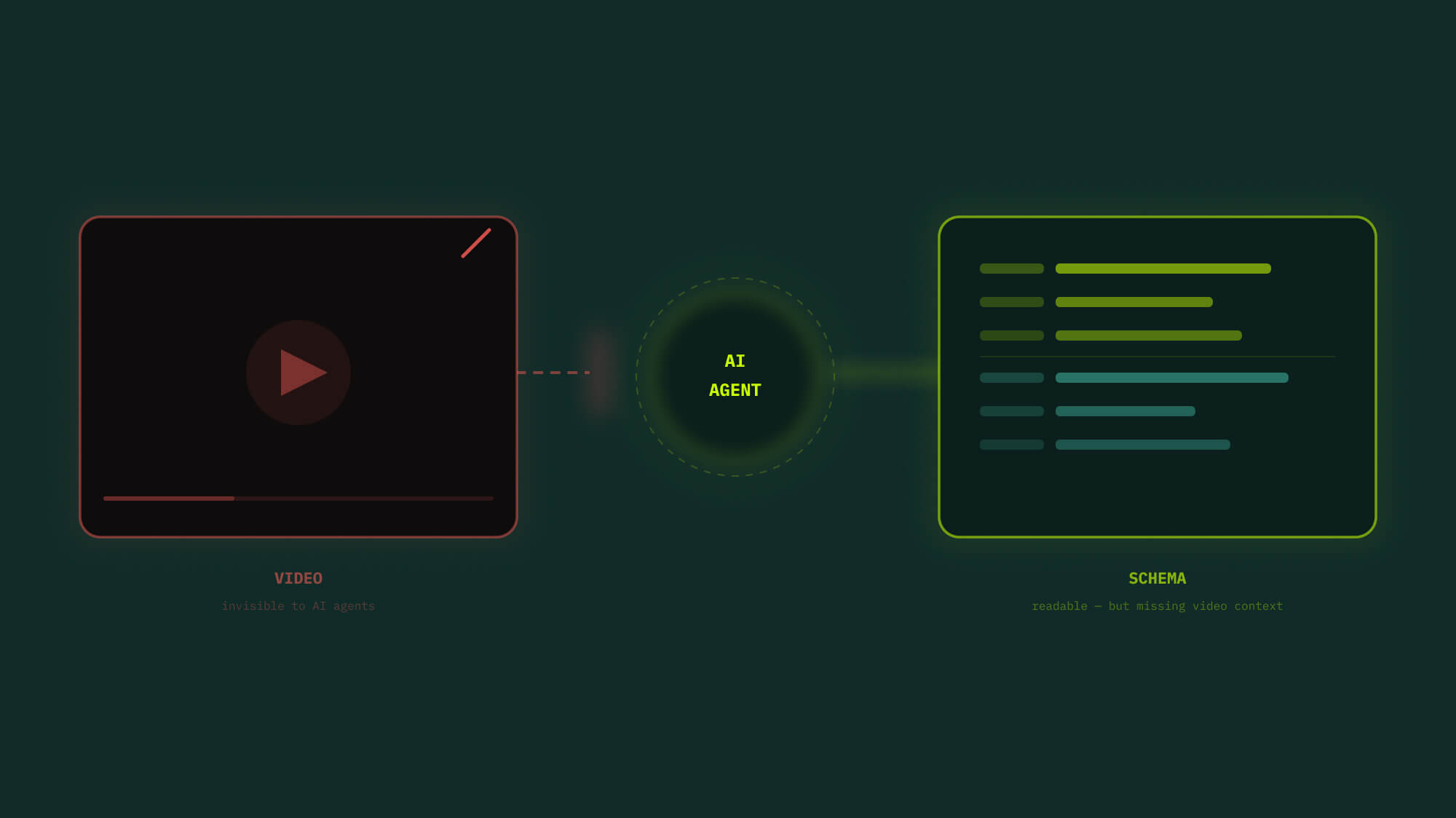
For AI shopping agents, your video content is a complete dead end.
AI agents cannot watch videos. When an agent crawls your PDP and encounters a product video, it either sees an iframe it can't interpret or a video file it can't play. Everything inside that video - every attribute, every use case, every comparison, every founder's explanation of why the formula works - is inaccessible. The agent completes its 5 jobs without any of that information.
Here's why this is worse than it sounds: most brands put their best product information into video. The detailed ingredient explanation that doesn't fit in the product description? It's in the founder video. The comparison between the two sizes? It's in the how-to clip. The answer to "is this right for sensitive skin?" is in the UGC testimonial. All of it is invisible to the agent trying to match your product to a buyer's specific question.
The agent who can't read your video doesn't know it's missing anything. It forms its recommendation from whatever text and structured data it can extract, treats the video as irrelevant, and sends the shopper to your page with incomplete information. Then the shopper arrives, watches the video, and either confirms or contradicts what the AI told them.
When Videowise indexes video content, it generates a VideoObject schema and structured Q&A from the video's content, turning the information inside the video into something the agent can actually read. The agent doing Job 2 (match product attributes to buyer's situation) suddenly has access to everything your founder explained on camera. See how Built For Athletes structured their video content to drive +18.9% revenue per visitor and +12% CVR within a month of implementation.
There's a type of PDP problem that doesn't show up in any standard analytics report but damages AI-referred conversions significantly: contradictory information across your content.
An AI agent building a product recommendation doesn't just read your PDP. It may have read your homepage, your about page, your blog content, and your structured data - all before forming the recommendation it used to send the shopper to you. If those sources contradict each other, the agent's recommendation reflects that contradiction.
Common contradiction patterns:
Auditing for consistency is not glamorous work. But for AI-referred traffic - which is growing as a share of ecommerce sessions and converts at higher rates than most other sources - it's one of the highest-leverage things a brand can do.
Run through the 5 jobs above and ask, for each one: does my PDP give an agent what it needs? Here's what that looks like in practice.
Your product title should name the product type, key attribute, and size or format - not just the brand and product name. "Whey Protein Isolate - Chocolate, 2lb" gives an agent something to work with. "Perform Blend - Choco" does not. Your opening description should repeat the product name and its primary purpose in the first two sentences. Agents weight the first 100 words heavily.
Go through your last 30 support tickets. Every question your team answered manually: "does this contain gluten?", "what's the weight capacity?", "can I use this with a Mac?" - is an attribute your PDP needs to answer in plain text. Not in a PDF. Not in a chatbot. In static HTML on the product page where an agent can read it on crawl.
Add one or two sentences to your product description that say when this product is the right choice and when it isn't. "Better for daily carry than weekend travel" is comparison context. "Great for everyone" is not. Agents use this to decide when to recommend your product over an alternative.
Rewrite your policy copy with specific numbers. "30-day returns on unused items in original packaging. Refunds within 3-5 business days. Free return shipping on orders over $50." Every specific number is something an agent can extract and cite with confidence. "Hassle-free returns" is noise.
Make sure there's a clear primary CTA on the page and that variant selection is guided. An agent trying to recommend "add to cart" shouldn't be confronted with six size options, a color picker, a subscription toggle, and a "compare sizes" link with no guidance on which to choose. The page's hierarchy of actions should be clear.
The video problem described above (agents can't read the content format that most completely answers their 5 jobs) is specifically what Videowise is built to solve. Here's how it closes each part of the loop.
When you embed video through Videowise, it doesn't just place a player on your PDP. It generates VideoObject JSON-LD for every video - name, description, thumbnail, duration, upload date - so AI agents can parse the video's existence and context without watching it. More importantly, Videowise extracts the content from within the video: the product attributes explained on camera, the use cases demonstrated, the comparisons drawn, the questions answered by the founder or customer. That content becomes structured Q&A in your page's JSON-LD, directly feeding Jobs 2, 3, and 4 that agents need to complete.
A brand with a 90-second founder video explaining why their protein formula uses isolate instead of concentrate, who it's ideal for, and how it compares to the cheaper options on the market - that brand now has five or six FAQ entries derived from that video, all crawlable, all citable. The agent doing attribute matching on that product page has the answer. The agent working on comparison context has the answer. None of that required writing a single line of copy.
The structured data Videowise generates isn't injected by JavaScript after page load. It's in the HTML source when a crawler arrives. This matters because AI agents and search crawlers don't wait for JavaScript to run - they read what's in the source and move on. If your FAQ schema or VideoObject markup appears only after a JS widget initializes, the agent that landed 200ms earlier already left without it. Videowise renders all structured content server-side, so the agent that crawls your PDP at 3am finds everything on the first pass.
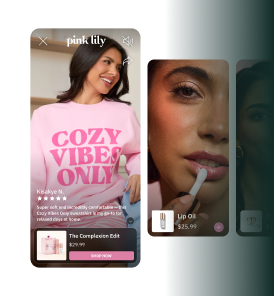
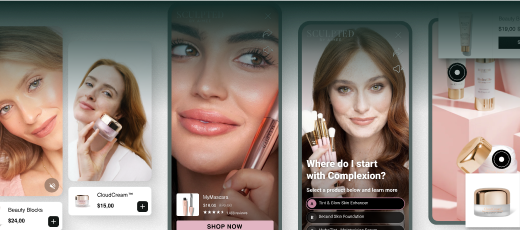
Everything above serves the AI agent. This step serves the human shopper the agent sent. When an AI-referred buyer lands on your PDP, they've already formed expectations based on the agent's recommendation. Videowise's shoppable video carousel is what converts that expectation into a transaction: they see the product in use, in context, from real customers or the brand's own content, and they can add directly to cart without leaving the video experience.
This is where the loop closes completely. The agent read the video's structured content to form its recommendation. The shopper arrives and watches the video itself to confirm the recommendation. The same content asset does both jobs.
Built For Athletes saw +18.9% revenue per visitor and +12% CVR within one month of deploying shoppable video on their PDPs. ALPAKA ran a controlled A/B test and measured +7.8% CVR and +7.24% revenue directly attributable to the video carousel. Dalstrong measured +22.7% revenue uplift and +22% revenue per session in their A/B test.
The brands winning on AI-referred traffic are not doing two separate optimization projects: one for AI discovery and one for on-page conversion. They're doing one: building video content that's structured for agents and compelling for shoppers. Videowise makes those the same project.
AEO (Answer Engine Optimization) is about getting discovered and cited in AI search results - the indexing and citation layer. AI-ready PDPs are about what happens after that discovery: when an AI agent or AI-referred shopper arrives on your product page, can it extract what it needs to complete a purchase recommendation? These are two separate problems. A brand can be well-cited in AI search and still have PDPs that break down when AI agents try to work with them.
AI-referred traffic often appears in Google Analytics 4 under referral sources including perplexity.ai, chatgpt.com, bing.com (when originating from Copilot), and occasionally as direct traffic with strong purchase intent signals. Look for sessions with high conversion rates and low time-on-site - AI-referred shoppers often convert faster because they arrive with pre-formed intent. Shopify Analytics also tracks "AI-assisted" orders in some regions.
Only if those captions are rendered in static HTML that crawlers can access. Most video caption systems render via JavaScript or are embedded as subtitle tracks that crawlers don't parse. VideoObject schema with a transcript property, or FAQ schema derived from the video's content, is the reliable path to AI readability, not captions. Videowise handles this automatically: it generates VideoObject JSON-LD and structured Q&A from your video content server-side, so crawlers find it on the first pass without any manual schema work.
Shopify generates basic Product schema for all stores - name, price, availability, image. But it doesn't generate FAQ schema, VideoObject schema, review aggregates (unless a review app adds them), or the detailed attribute and comparison content agents need to complete Jobs 2 and 3. Native schema is a starting point, not a complete solution. For video specifically, Shopify has no native indexing at all - that gap is what Videowise fills.
Unlike traditional SEO, improvements that affect on-page experience take effect immediately for shoppers who arrive after the change. An AI agent's recommendation is cached until it re-crawls your page (which varies by platform), but once it updates, the new recommendation reflects your improved content. For on-page conversion by AI-referred shoppers, changes take effect the moment the page is live.
5 Jobs AI Shopping Agents do on your PDP
What Your PDP Actually Needs to Give AI Agents
How Videowise Closes the Gap for AI Shoppers


.jpg)
.jpg)