.jpg)
.jpg)
Something shifted in 2024 and most ecommerce brands are still catching up. Zero-click searches crossed 65% for the first time. More than half of all Google queries now end without anyone clicking through to a website. The answer appears in the result, the user is done, and your carefully optimized page never gets seen.
Then came AI Overviews. Then Perplexity's product recommendations. Then ChatGPT shopping mode. The top of funnel stopped belonging to ranked pages. It started belonging to whichever sources AI systems trust enough to cite.
Answer Engine Optimization (AEO) is the discipline built to solve exactly this problem. It is how ecommerce brands structure their content so AI systems can extract it, trust it, and use it to answer buyer questions. This guide covers what AEO actually is, how it differs from SEO, what LLM crawlers look for on a Shopify product page, and how to start building it in.
AEO is the practice of structuring your content so AI-powered answer engines (ChatGPT, Perplexity, Google Gemini, Claude) can extract, evaluate, and cite it when answering buyer questions.
Where SEO targets your position in a list of ten links, AEO targets whether your brand gets named in a single direct answer. That distinction sounds minor. It is not. When a shopper asks ChatGPT "what is the best ceramide moisturizer for sensitive skin?" and your product gets named in the answer, the visitor who clicks through already has their question answered. They know your product was recommended. They are not browsing. They are buying.
AEO covers four areas. Getting one right is not enough; the whole system has to work together.
.jpg)
Traditional SEO is linear. A user searches, Google ranks pages, the user clicks, the brand converts. Four steps, with friction at each. The brand's job is to appear near the top and survive the comparison with nine competitors on the same page.
The AEO model compresses that funnel. When an AI engine answers a question by naming your product, the visitor who clicks through arrives already convinced. The click is nearly a formality. That is also why the failure mode is so severe: if your brand is not in the answer, there is no fallback. No page two. No paid search to catch the drop-off. The answer just does not include you.
Several classic SEO habits carry over directly into AEO. Technical correctness still matters: fast, crawlable pages help. Answering real questions wins in both contexts. Authority signals build the entity trust AI systems use when evaluating sources. Freshness matters more, not less.
Three habits that worked in SEO actively mislead you in AEO. Keyword density is irrelevant because AI systems extract meaning, not occurrence counts. Meta descriptions are ignored because AI reads page content directly. And ranking position means nothing if an AI decides to pull from a competitor's FAQ section instead of your homepage.
For a deeper look at how video content fits into an SEO and AEO strategy together, the video SEO strategies guide covers the overlap in detail.
To optimize for AI citations, you need to understand what AI crawlers actually do when they visit a page. They are not ranking it. They are extracting meaning.
Traditional search crawlers index content and calculate relevance signals. LLM-based crawlers (GPTBot, PerplexityBot, ClaudeBot, and Google's AI crawlers) extract entities, factual claims, direct answers to specific questions, and structured product attributes. They are building training data and citation sources, not a ranking index.
What they extract well: named entities like brand names, product names, and ingredients; factual claims like "formulated for sensitive skin" or "paraben-free"; Q&A pairs with explicit questions and direct answers, especially via FAQ schema; and product attributes including price, ratings, and availability.
What they cannot process: JavaScript-rendered content that loads only after client-side code runs, video files (they cannot watch them), images without adjacent structured context, and unstructured prose with no clear extractable claim.
The structural gap for most ecommerce brands is the same everywhere: their most credible product content (creator videos, UGC testimonials, product demos) lives in a format AI simply cannot read.
The most credible answers to buyer questions are usually already in your video library. A creator who says "I have super-reactive skin and this is the first moisturizer I have used in three years without a flare-up" answers "is this safe for sensitive skin?" better than anything a brand copywriter could write. It is specific, personal, and verifiable. AI systems want to cite exactly this kind of content. They just cannot watch the video.
But they can read a structured Q&A that extracts that moment:
Q: Is Kosas Ceramide Barrier Cream safe for reactive skin?
A: Yes. The formula is fragrance-free, paraben-free, and dermatologist-tested for sensitive skin. Verified customer reviews from reactive skin users report no irritation after 90 days of daily use.
That is machine-readable. That is citable. That is what AEO looks like in practice.
The brands getting ahead in AEO right now are not the ones producing the most content. They are the ones who have figured out how to translate what lives in video into structured, crawlable text, while keeping the video itself as the trust layer for shoppers who click through and want to verify.
Research across Videowise merchants puts the conversion lift from on-site video at 9 to 17% in A/B tests. The full analysis is in the video commerce ROI guide. The same content driving that conversion lift is the content that, when structured correctly, powers your AEO engine.
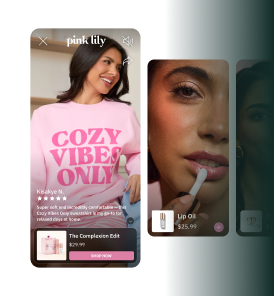
A product page that earns AI citations has five things working in concert. You can rank on Google without all five; you cannot reliably get cited by AI with any of them missing.
Here is a practical sequence for a Shopify brand starting from scratch on AEO. Each step builds on the last. Start with the audit, it shows exactly where your biggest gaps are before you touch any code.
For current benchmarks on how ecommerce brands are driving measurable outcomes through structured content and video, the ecommerce statistics guide has data across conversion, traffic, and content performance.
Steps 1 through 5 are doable with a developer and a couple of days. Step 6: extracting buyer Q&As from video at scale, getting them approved, and deploying them server-side on every relevant PDP is where most brands stall.
Doing it manually means watching hours of video to find citable moments, writing clean Q&A pairs from each one, getting them through a review workflow, and then figuring out how to inject them into your Shopify theme as SSR HTML rather than a JavaScript widget. For a catalogue of a hundred products, this is a full-time job.
Ready to see which buyer questions AI is already answering in your category, and whether your brand shows up? Book a free AI visibility audit and we will run the scan together.
AI search is not replacing ecommerce traffic. It is reshaping where qualified buyers come from. The brands that show up in AI answers get pre-sold visitors. The ones that do not are invisible to a growing share of the market.
The infrastructure work (schema, SSR, structured Q&A from video) is not theoretical. It is the difference between being cited and being absent. And the brands doing it now are building a citation moat that compounds as AI search volume grows.
AEO (Answer Engine Optimization) is the practice of structuring ecommerce content so AI systems like ChatGPT, Perplexity, and Google Gemini can extract, trust, and cite it when answering buyer questions. It focuses on structured Q&A, product schema, and server-rendered content that AI crawlers can read.
SEO optimizes for ranking position in a list of results. AEO optimizes for being cited in a direct AI answer. AEO requires structured Q&A markup, server-side rendering, and content that answers specific buyer questions, rather than keyword-dense copy optimized for ranking algorithms.
No. AI crawlers like GPTBot and PerplexityBot cannot watch or process video files. To make video content citable, brands need to extract the key questions and claims from their video library and publish them as structured, server-rendered Q&A text on the product page. Platforms like Videowise automate this pipeline.
The most impactful schema for AEO is FAQ schema (JSON-LD) with real buyer questions and direct answers, combined with Product schema with full attributes including brand, description, price, and rating. Both need to be rendered server-side in the initial HTML response to be readable by AI crawlers.
Early citation gains can appear within two to four weeks of deploying structured Q&A and schema markup, depending on how quickly AI systems recrawl your pages. Sustained coverage across a full catalog takes longer and depends on content depth and entity authority built over time.


.jpg)
.jpg)