.jpg)
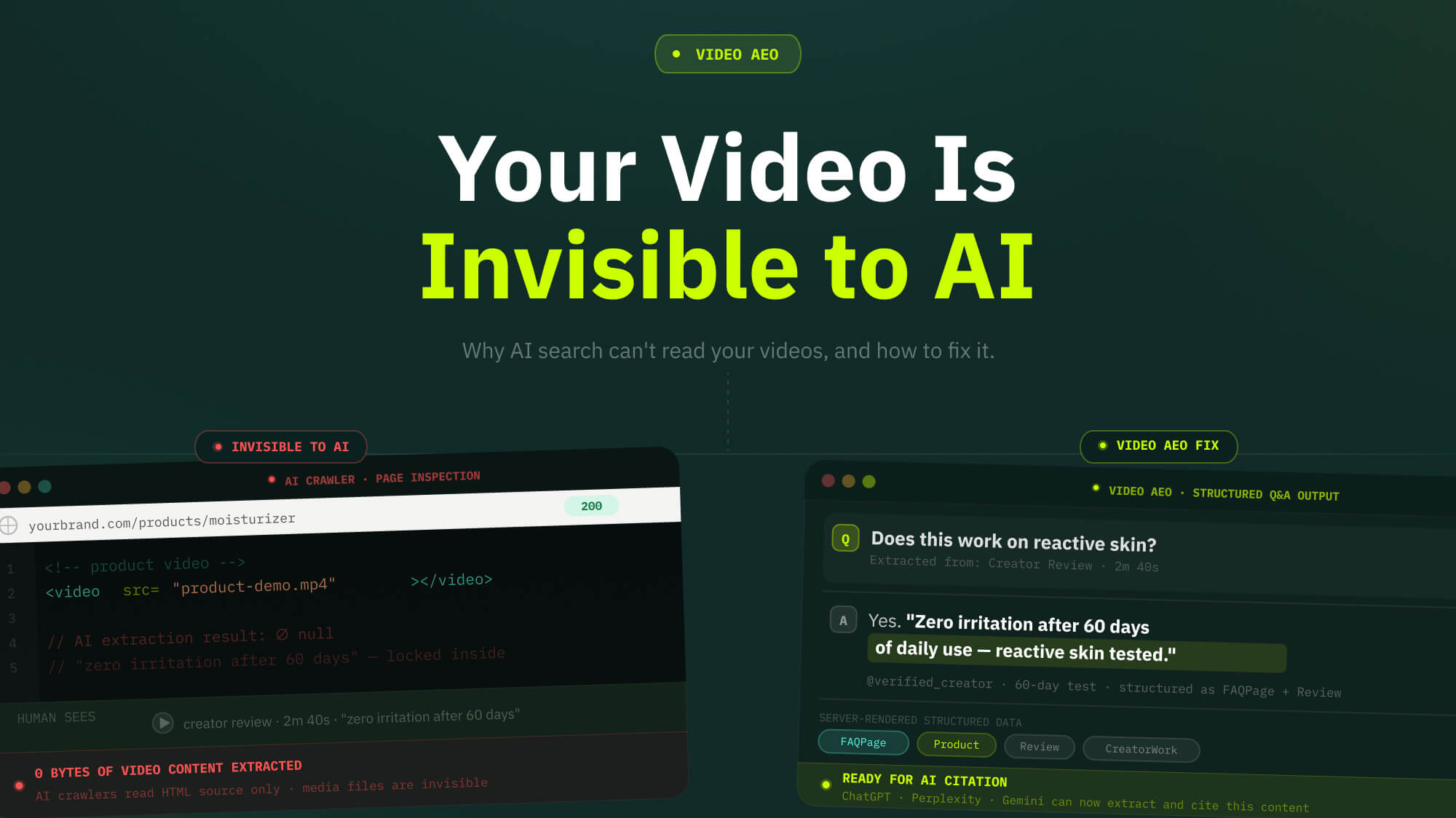
If your brand has invested in creator reviews, UGC testimonials, or product demos, those videos are doing nothing for your AI search presence. ChatGPT cannot watch video. Perplexity cannot process it. Gemini cannot understand what your creator said about your moisturizer's effect on reactive skin. AI engines read HTML. And unless your video content has been converted into structured, server-rendered text, AI search will recommend your category, name your competitors, and never mention you.
This is a structural problem, not a content problem. The proof already exists in your video library. It is in the wrong format.
This guide explains exactly why video is invisible to AI crawlers, which types of video content are worth converting first, and the four-step process to go from invisible to cited.
When GPTBot, ClaudeBot, or PerplexityBot crawls your product page, it reads one thing: the initial HTML response from your server. It does not execute JavaScript. It does not scroll. It does not interact with the page at all. It reads the raw HTML source and moves on.
A video file appears in that HTML as something like <video src="product-demo.mp4"> or as an iframe pointing to YouTube or TikTok. The crawler sees a media reference. It extracts nothing from inside it. The creator describing your serum's effect after 60 days, the founder explaining the formulation decision, the customer comparing your product to three others she tried: none of that content reaches the crawler.
This is not a bug. It is how web crawlers work. The same limitation applies to Googlebot when it indexes video content for traditional search, which is why video SEO has always required text transcripts and structured metadata. AI crawlers have the same constraint, and the stakes are higher because AI answers are zero-sum: either your brand gets named or a competitor does.
For most Shopify brands, the invisibility problem goes beyond video files. Review widgets, Q&A panels, and product specification tables are commonly loaded client-side via JavaScript. They appear on the page for human visitors, but they do not exist in the initial HTML response that AI crawlers see.
If your Shopify store uses a third-party review app, a UGC widget, or a video player app, the content those apps render is almost certainly loaded after page render by JavaScript. Your best social proof, the reviews with specific claims, the Q&A answers that handle objections, is invisible to AI search.
The only content AI crawlers can read is what appears in view-source on your page. Open your product pages in browser and check. Everything that is not in that raw HTML source is invisible.

Not all video translates equally into AI citations. The types that convert best share one trait: they contain specific, verifiable claims that can be attributed to a real person or a piece of evidence. Here is how the main categories rank for AEO value.
Creator reviews rank highest. A creator saying "I have reactive skin and this caused zero irritation after 60 days of daily use" is specific, attributable, and verifiable. It is the kind of claim an AI system can extract, attribute to a named source, and cite in a product recommendation. Vague praise ("love this product, smells amazing") has low AEO value because it cannot be cited as evidence.
UGC testimonials are close behind. Authentic first-person buyer language tends to answer the exact questions AI gets asked. "I wear a size 9 and the medium fits perfectly" is more citable than any product description your brand could write.
Product demos answer "show me how this works" questions directly. A video showing a bag fitting under an airplane seat answers a question more convincingly than a spec sheet listing dimensions. When that content is converted to text, it becomes a strong citation candidate for practical fit and size questions.
Brand and educational content (founder stories, ingredient explanations, sourcing transparency) contributes to entity authority rather than direct citations. It tells AI systems that your brand is a credible source, which affects how much weight the system gives your product claims elsewhere.
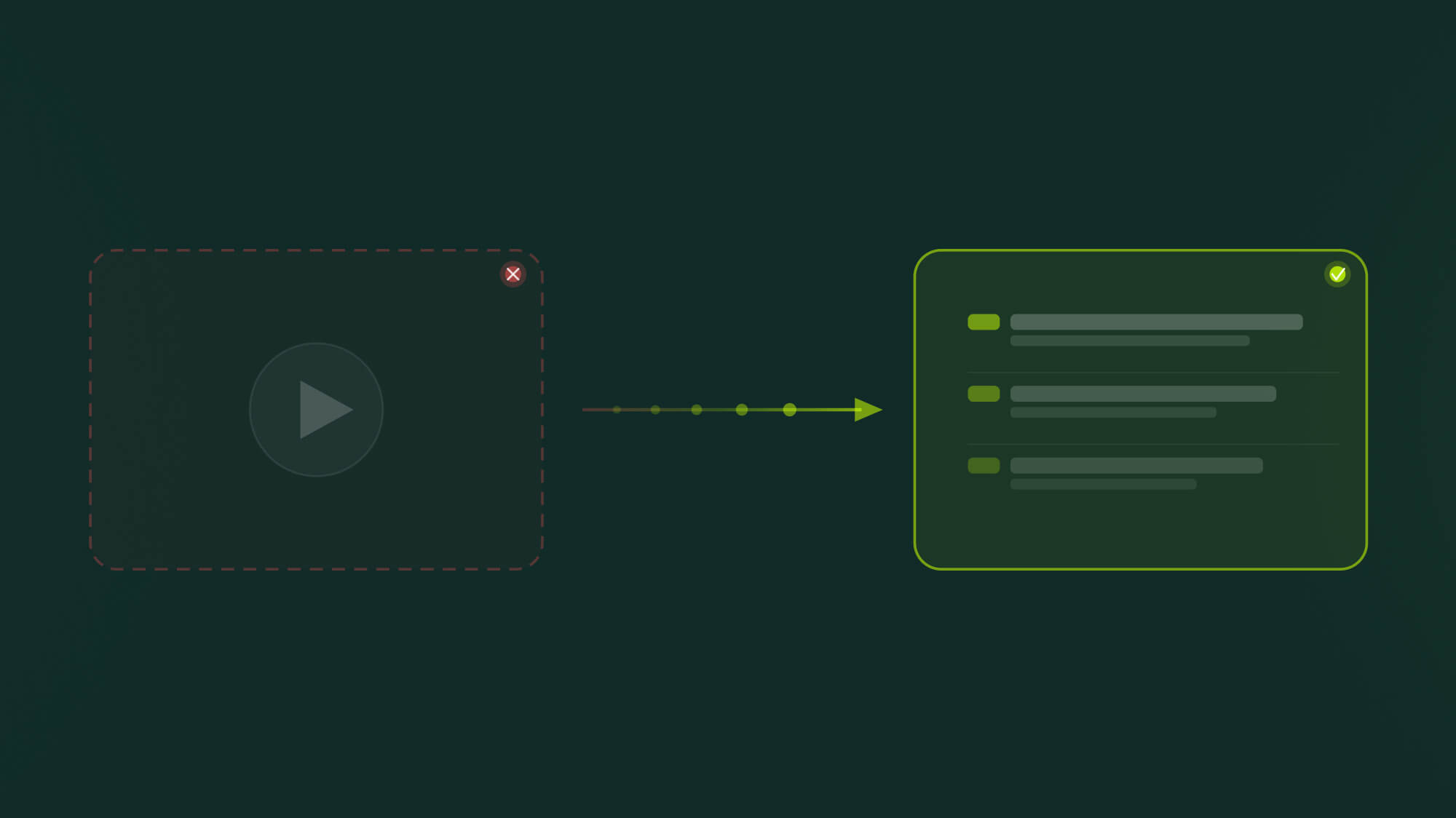
The process of making video content readable by AI crawlers has four steps. At small scale, a team can run this manually in a sprint. At catalog scale, it needs automation, and that's where Videowise comes in.
For a full overview of how AEO works and how it differs from traditional SEO, the AEO ecommerce guide covers the technical foundation.
AI systems do not treat all Q&A content equally. They have preferences, and those preferences are consistent enough to engineer for.
The single biggest factor is specificity. Compare these two answers to the same question:
Brand copy: "Yes, our formula is gentle and perfect for all skin types including sensitive skin."
Citable: "Yes. Fragrance-free and paraben-free. In a panel of 200 users with self-reported sensitive skin, 94% reported no irritation after 30 days of daily use. Reviewed by a board-certified dermatologist."
The second answer has evidence. It has a sample size. It names a type of expert. AI systems treat it as a source worth citing. The first reads as promotional copy and gets deprioritized accordingly.
The other factors that matter:
For a brand with 10 hero products and 40 creator videos, the manual process above is manageable. A marketing team can do it in a sprint, and the results are measurable within weeks.
For a brand with 200 SKUs and 600 UGC clips, it is a full-time operation. Reviewing video to find citable moments, writing Q&A pairs, routing them through approval, deploying them as server-rendered HTML on the right product pages,. each step is labor-intensive, and the process repeats every time new video comes in.
Videowise AI Visibility automates the full pipeline. It scans your video library, identifies citable moments using AI, surfaces structured Q&A pairs for team review, and deploys the approved content as SSR-rendered HTML on product pages and a dedicated video Q&A page. The Q&A widget serves two functions simultaneously: it helps shoppers find answers using creator proof (Videowise merchants see 9-17% conversion lifts in A/B tests), and it gives AI crawlers the structured, verifiable content they need to cite your brand.
For video conversion benchmarks across Videowise merchants, the video commerce ROI guide has the full data set. And for the broader context on how AI search is changing ecommerce traffic, the ecommerce statistics guide covers the current numbers.
Once your structured Q&A is deployed, run this check every 30 days:
AEO citations compound. Early coverage builds the entity authority that makes future citations easier to earn. Brands that delay structured content deployment are not just missing citations today, they are letting competitors build authority that will take longer to displace.
For more on the video SEO strategies that support this work, including transcript optimization and video schema for traditional search, see the video SEO strategies guide.
AI crawlers like GPTBot and PerplexityBot read the initial HTML source of a page but cannot play or process video files. A video embed appears as a media reference in HTML and the crawler extracts nothing from it. They also skip any content loaded by JavaScript after page render, which includes most video player apps and review widgets on Shopify stores.
Extract citable Q&A pairs from your video library, format them with FAQ schema JSON-LD, and deploy them as server-rendered content on your product pages. The text must appear in the initial HTML response, visible in the page view-source. Also create a dedicated video Q&A hub page that aggregates all structured Q&A from your video library.
Video AEO (Answer Engine Optimization) is the process of extracting structured Q&A content from ecommerce video -- creator reviews, UGC testimonials, product demos -- and deploying it as server-rendered HTML with FAQ schema so AI engines like ChatGPT and Perplexity can read, extract, and cite it in product recommendations.
Creator reviews and UGC testimonials have the highest AEO value because they contain specific, first-person, verifiable claims that AI systems can attribute to real sources. Product demos rank next for answering fit and usage questions. Educational brand content contributes to entity authority rather than direct citations.
Citable Q&A pairs are specific, factual, and attributable. They include measurable claims (study sizes, percentages, named experts), are written in natural buyer language, appear as server-rendered HTML with FAQ schema, and avoid promotional brand copy. Vague praise and unattributed claims get deprioritized by AI systems.


.jpg)
.jpg)