

Table of Contents
- Introduction
- Defining Live Commerce for the Modern Merchant
- The Revenue Case: Why Live Commerce Outperforms Static Pages
- Strategic Implementation: How to Build a Live Selling Program
- Performance-First Infrastructure: A Technical Requirement
- Measuring Success: Beyond Engagement Vanity Metrics
- Common Obstacles and How to Overcome Them
- The Future of Live Commerce in 2026
- Conclusion
- FAQ
Introduction
Ecommerce operators in 2026 face a persistent challenge: the rising cost of customer acquisition paired with a plateau in traditional conversion rates. Static product pages, once the gold standard, often fail to bridge the gap between digital convenience and the tactile confidence of in-store shopping. This is where live commerce provides a high-yield solution. By merging real-time video broadcasting with instant checkout capabilities, brands can collapse the marketing funnel from awareness to purchase in a single session.
At Videowise, we focus on turning these video interactions into measurable revenue through a shoppable video platform built for performance. This guide provides a clear live commerce definition, explores the strategic advantages for Shopify retailers, and outlines the technical requirements for scaling a live selling program without compromising site performance. We will examine why this format drives higher revenue per session and how to implement it as a core growth lever.
Defining Live Commerce for the Modern Merchant
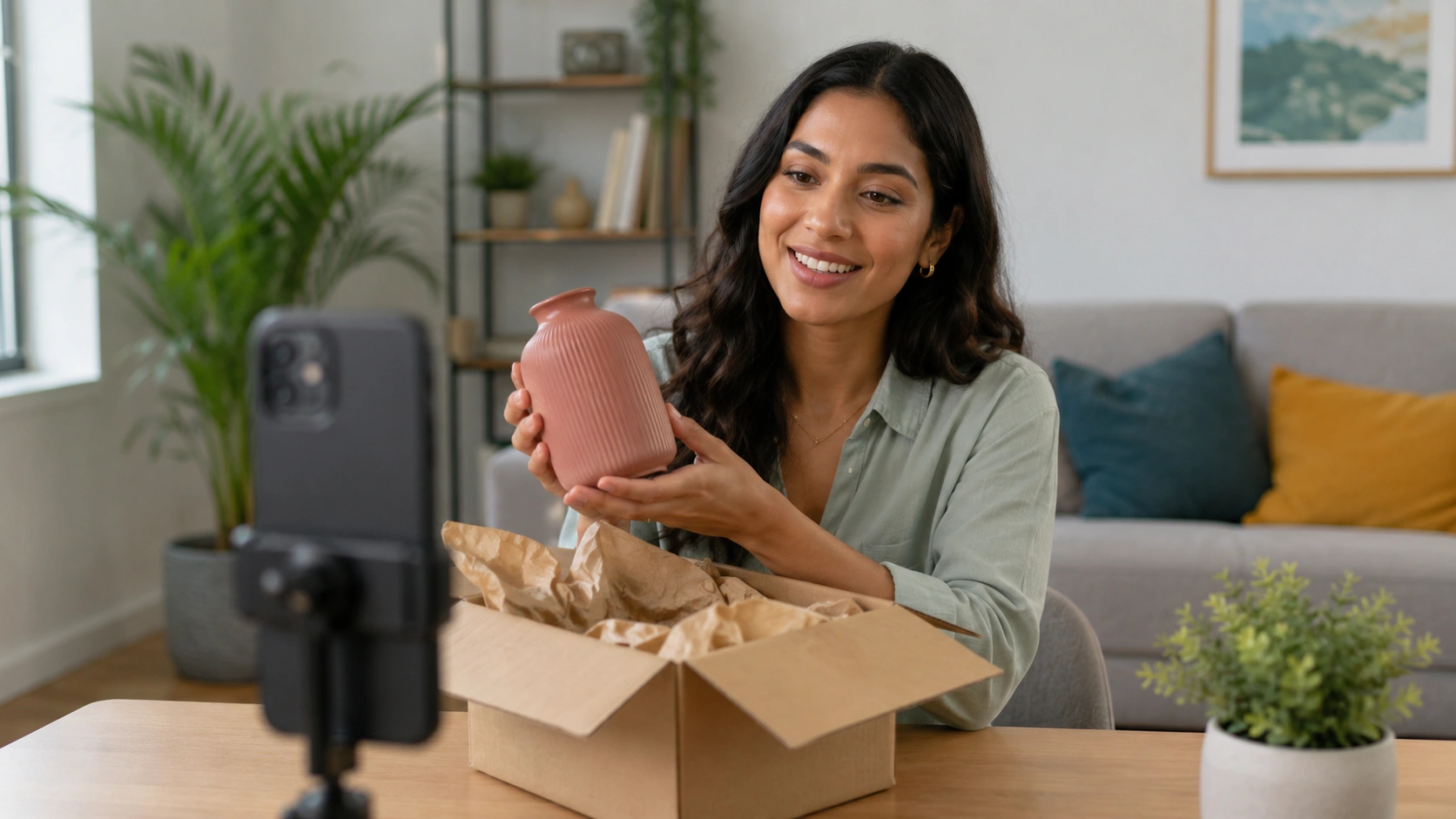
In its simplest form, the live commerce definition is the marriage of livestreaming and ecommerce. For brands that want that experience on their own storefront, a live shopping platform makes it possible to demonstrate products via a live video feed, allow viewers to interact through chat, and purchase featured items in real-time without leaving the player.
While often compared to the television shopping networks of the 1970s and 80s, modern live commerce is significantly more advanced. It is interactive, data-driven, and designed for mobile-first consumption. Unlike a one-way television broadcast, live commerce enables a two-way dialogue. Shoppers can ask questions about fit, material, or usage, and the host can provide immediate answers, effectively removing friction from the buying process.
The Technical Anatomy of a Live Stream
For an ecommerce director, understanding the technical components is vital for ensuring a stable customer experience. A functional live commerce setup requires three core elements:
- The Video Feed: A low-latency (minimal delay) broadcast that transmits the host’s presentation to the audience.
- The Interactive Layer: A real-time chat and reaction interface that facilitates community engagement and direct Q&A.
- The Commerce Layer: An integrated checkout system that allows viewers to click on product tags within the video and add items to their cart or complete a purchase instantly.
Live Commerce vs. Social Commerce
It is important to distinguish live commerce from the broader category of social commerce. Social commerce refers to any shopping experience that occurs on a social media platform, such as a static post on Instagram with a product tag. Live commerce is a specific format within that ecosystem—or on your own site—defined by its real-time, video-driven nature.
While social platforms like TikTok Shop have popularized live selling, many enterprise brands are now bringing this experience directly to their own domains to retain control over customer data and the checkout experience.
The Revenue Case: Why Live Commerce Outperforms Static Pages
For most Shopify brands, the primary motivation for adopting live commerce is the significant lift in Conversion Rate (CVR). Traditional ecommerce websites typically see conversion rates between 2% and 3%. In contrast, well-executed live commerce events often report conversion rates as high as 20% to 30%, depending on the product category and the strength of the offer. For a closer look at live selling in practice, see a live shopping case study.
Key Takeaway: Live commerce compresses the sales cycle by providing immediate social proof and real-time objection handling, leading to conversion rates that can be 10x higher than standard product detail pages (PDPs).
Driving Higher Revenue Per Session (RPS)
Revenue Per Session (RPS) is a critical metric for growth managers because it accounts for both conversion rate and Average Order Value (AOV). Live commerce naturally increases RPS through several mechanisms:
- Bundling and Upselling: A host can visually demonstrate how multiple products work together, encouraging shoppers to purchase sets rather than individual items.
- Urgency and Scarcity: Limited-time offers or exclusive "live-only" discounts create a psychological trigger that prompts immediate action.
- Reduced Return Rates: One of the most overlooked benefits of live commerce is its impact on returns. When customers see a product demonstrated in real-time and have their specific questions answered, they are less likely to experience "buyer's remorse" or receive an item that doesn't meet their expectations.
Closing the "Trust Gap"
Online shopping often suffers from a trust gap—the uncertainty a shopper feels when they cannot touch or see a product in person. Live commerce humanizes the brand. Whether the host is the founder, a product expert, or a trusted influencer, their presence provides a level of authenticity that a static image cannot replicate. This is particularly effective for high-consideration categories like skincare, electronics, or luxury fashion.
Strategic Implementation: How to Build a Live Selling Program
Implementing live commerce requires a balance of technology, talent, and timing. For an operator, the goal is to create a repeatable workflow that scales with the brand's growth.
Step 1: Selecting the Right Format
Not every live stream needs to be a massive production. Brands should choose a format that aligns with their specific goals:
- The Product Drop: Best for generating hype around a new launch. Use a high-energy host and exclusive live-only inventory.
- The Educational Workshop/Tutorial: Ideal for complex products. Focus on "how-to" content and deep-dive Q&A to remove purchase barriers.
- The Behind-the-Scenes: Great for brand storytelling and building loyalty. Show the manufacturing process or the team behind the products.
- The Influencer Takeover: Leverages an external creator’s audience to drive new customer acquisition.
Step 2: Choosing Your Platform
Operators must decide between hosting the event on a social platform (off-site) or their own ecommerce store (on-site).
- Off-Site (Social Platforms): High reach and ease of discovery, but limited control over customer data and often higher platform fees.
- On-Site (Branded Store): Lower reach initially, but higher quality traffic. On-site live commerce allows you to own the entire customer journey and integrate the experience with your existing loyalty programs and email marketing flows.
We provide the tools to bridge this gap, and you can book a demo to see how brands broadcast high-performance live shopping events directly on their Shopify storefronts. This ensures that the traffic you work hard to acquire stays on your domain, where you have full control over the data and the brand experience.
Step 3: Identifying and Training Talent
The host is the most critical element of the stream. They don't need to be a professional broadcaster, but they must be knowledgeable, engaging, and capable of multi-tasking between the product demo and the chat feed.
- Founders: Bring unparalleled passion and brand knowledge.
- Store Associates: Often the best at handling product-specific objections because they do it every day in person.
- Influencers: Bring an existing audience but require a clear brief to ensure brand alignment.
Step 4: Technical Setup and Testing
Before going live, a technical rehearsal is non-negotiable. This should include a check of:
- Audio Quality: Poor sound is the fastest way to lose an audience. Invest in a dedicated microphone.
- Lighting: Ensure the product is clearly visible without harsh shadows.
- Integration Sync: Verify that the product tags in the video correctly sync with your Shopify inventory and that the checkout flow is functional.
Performance-First Infrastructure: A Technical Requirement
A common concern among ecommerce directors is that adding video components—especially live ones—will slow down their site. This is a valid fear. Core Web Vitals, specifically Largest Contentful Paint (LCP), are critical for both SEO and user experience. If you want a clearer view of how video contributes to those outcomes, Content Performance analytics can help you measure what matters.
Myth: Adding live video to my storefront will significantly slow down my page speed and hurt my SEO rankings. Fact: When using a performance-optimized platform like Videowise, live video is loaded through advanced techniques like viewport loading and optimized scripts, ensuring that your Core Web Vitals remain healthy while delivering a high-definition experience.
Managing Latency and Scale
For a live event to be successful, it must be "low-latency." If the host asks a question and there is a 30-second delay before they see the chat responses, the interactivity is lost. Modern live commerce platforms use advanced Content Delivery Networks (CDNs) to ensure that the broadcast reaches thousands of viewers simultaneously with minimal lag.
Inventory and Checkout Integration
A live event can trigger a massive spike in traffic and transactions in a very short window. Your infrastructure must be able to handle this "flash sale" behavior. Real-time inventory syncing is essential; nothing kills the customer experience faster than a shopper clicking "Buy" on an item that sold out five minutes ago but is still being promoted by the host.
| Feature | Standard Video | Live Commerce |
|---|---|---|
| Interactivity | Passive | High (Real-time Q&A) |
| Typical CVR | 3% - 5% | 15% - 30% |
| Sense of Urgency | Low | High (Live-only offers) |
| Primary Goal | Awareness/Education | Immediate Conversion |
| Production Need | High (Edited) | Medium (Raw/Authentic) |
Measuring Success: Beyond Engagement Vanity Metrics
While "views" and "likes" are easy to track, they do not tell the full story of your live commerce ROI. Operators should focus on video commerce ROI that links video views directly to the bottom line.
Core Metrics to Track
- Direct Revenue: Sales completed within the live player or during the session.
- Influenced Revenue: Sales completed by viewers within a set window (e.g., 24–48 hours) after watching the stream.
- Revenue Per Session (RPS): The average dollar amount generated every time a shopper engages with the live stream.
- Engagement-to-Purchase Ratio: What percentage of people who commented or reacted actually moved to checkout?
- Return Rate Comparison: Compare the return rate of products bought during live events versus those bought through standard PDPs.
Using AI for Content Intelligence
In 2026, AI is playing a larger role in how we analyze live content. AI clips and usage rights management allow brands to repurpose successful live segments into short-form clips. For example, if a 30-minute live stream has a 5-minute segment where the host explains a specific feature particularly well, our platform can help you identify that high-performing moment and turn it into a permanent shoppable video for the corresponding PDP.
Bottom line: Live commerce is not just about the broadcast; it’s about the data you gather during the event and how you repurpose that high-converting content across your entire site.
Common Obstacles and How to Overcome Them
Transitioning to a live-first strategy isn't without its hurdles. Understanding these common friction points allows operators to plan more effectively.
Content Production Bottlenecks
Many brands assume they need a full studio and a professional crew to go live. In reality, authenticity often performs better than high-gloss production. A smartphone with a good ring light and a clear background is often enough to get started. The key is consistency, not perfection.
Audience Attendance
"What if no one shows up?" This is the most common fear. Building an audience for live events requires a multi-channel promotion strategy:
- Email/SMS Teasers: Send a "Save the Date" 48 hours before and a "We’re Live" link at the start.
- On-Site Banners: Use countdown timers on your homepage to build anticipation.
- Social Cross-Promotion: Use your existing social channels to drive traffic to the on-site event.
Platform Stability
Technical glitches during a live event can be devastating. This is why choosing a platform built specifically for ecommerce is vital. General-purpose streaming tools often lack the deep integration with Shopify’s checkout and inventory systems that are required for a fluid shopping experience.
The Future of Live Commerce in 2026
As we look toward the future of digital retail, live commerce is evolving from an "experimental" channel to a "mandatory" one. Several trends are shaping the next phase of this format.
AI-Powered Studio Tools
We are seeing a shift toward AI Studio capabilities that assist hosts in real-time. This includes AI-generated talking points based on real-time chat sentiment or automated product overlays that update based on what the host is holding up to the camera. These tools reduce the cognitive load on the host, allowing them to focus on the human connection.
Omnichannel Live Shopping
The future is not just on your site or just on social; it’s everywhere simultaneously. Brands are now looking for ways to broadcast a single live stream to their website, TikTok Shop, and the Shop App all at once. Live shopping inside Shop App is one useful example of how this channel can extend reach while centralizing inventory and order management.
Hyper-Personalization
With better data integration, live commerce sessions can become more personalized. Imagine a host seeing that a top-tier loyalty member has just joined the stream and being able to give them a personal shout-out or a custom discount code. This level of white-glove service, delivered at scale, is what will define the leading brands of 2026.
Conclusion
The live commerce definition is more than just a marketing buzzword; it is a fundamental shift in how Shopify brands interact with their customers to drive measurable revenue. By combining the authenticity of live video with the efficiency of modern ecommerce infrastructure, brands can overcome the trust gap and significantly improve their conversion rates and revenue per session.
At Videowise, our mission is to provide the performance-first technology that makes this transition possible. We enable retailers to deploy interactive, high-definition live shopping experiences that don't compromise on page speed or technical stability. The results—higher AOV, lower returns, and a more engaged community—speak for themselves.
If you are ready to move beyond vanity metrics and turn your video content into a primary revenue driver, get started on the Shopify App Store. Evaluate your current video strategy, identify your best brand storytellers, and start small. The brands that win in 2026 will be those that embrace the immediacy and intimacy of live commerce today.
FAQ
What is the most important metric for live commerce success?
While engagement is a good sign, Revenue Per Session (RPS) is the ultimate metric for success. It combines your conversion rate and average order value into a single figure that shows exactly how much value the live stream is adding to your bottom line.
Do I need expensive equipment to start live commerce?
No, most successful Shopify brands start with a smartphone, a high-quality microphone, and a basic lighting kit. The quality of the information and the authenticity of the host are much more important to viewers than Hollywood-level production values.
How does live commerce impact site speed?
If implemented correctly with an optimized platform, live commerce should have a minimal impact on site speed. By using viewport loading and efficient script management, our infrastructure ensures that the video elements only load as needed, protecting your Core Web Vitals and SEO.
Can live commerce help reduce product returns?
Yes, live commerce is one of the most effective tools for reducing returns. By showing the product in motion and answering specific customer questions in real-time, brands ensure that shoppers have realistic expectations and a deeper understanding of the product before they buy.
.webp)


